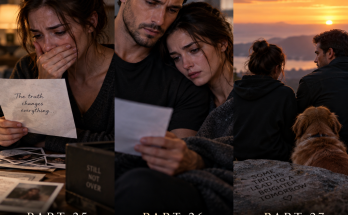
Mary Lou did not sleep during the flight.
She tried.
She lowered the shade, wrapped the airline blanket around herself, and closed her eyes.
Twenty minutes later, they opened again.
“You’re watching me,” she said.
“I’m sitting beside you.”
“That isn’t a denial.”
I looked back at my book.
I had been on the same page for almost an hour.
“Go to sleep.”
“You first.”
Neither of us did.
The cabin lights dimmed.
Around us, strangers settled into the ordinary discomfort of a long flight. Someone snored three rows behind us. A child cried briefly, then stopped. Flight attendants moved through the aisle with water.
Nothing dramatic happened.
I kept waiting for something dramatic to happen.
Perhaps Mary Lou did too.
Every time the seat-belt light chimed, she looked toward the aisle.
Every time someone walked past us, her shoulders tightened.
Eventually she noticed herself doing it.
“I thought leaving would make that stop.”
“It’s been six hours.”
“I know.”
“You had nine years of practice being afraid.”
She looked at me.
“That sounds like something Soo-jin would say.”
“I’m offended.”
“She would use better terminology.”
“That is worse.”
Mary Lou smiled.
Then the smile disappeared.
She looked toward the dark window.
“Do you think Ji-hoon is angry?”
“Because you left?”
“Because I didn’t stay for the letter.”
“You heard what mattered.”
“There may be more.”
“There will always be more.”
She turned.
I closed my book.
“That’s the problem with secrets. You start believing the next one will finally explain all the others.”
Mary Lou looked down at her hands.
“And it doesn’t?”
“Has it?”
No.
We both knew the answer.
Kang Jun had been frightened.
Brave.
Dishonest.
Protective.
Manipulative.
Loving.
Guilty.
Dead.
No final letter could make those things line up neatly.
Mary Lou leaned back.
“I wanted him to become simple.”
“What do you mean?”
“Either a good man who made mistakes or a bad man who loved me.”
She rubbed her thumb across the edge of the blanket.
“He won’t stay in either box.”
“Most people don’t.”
“You?”
“I’m extremely simple.”
She laughed softly.
“That may be the least true thing you’ve said.”
Several hours later, somewhere over the Pacific, Mary Lou finally slept.
Her head tilted toward me.
I did not move.
My shoulder went numb.
I let it.
When the pilot announced our descent, she woke immediately.
Not gradually.
Her eyes opened and she sat upright.
“Where are we?”
“Almost there.”
She lifted the shade.
Morning light poured through.
Clouds beneath us.
Then coastline.
America.
Mary Lou stared.
Her lips parted.
No tears.
Not yet.
Just concentration.
As though she could identify twelve missing years from the air.
The wheels touched the runway.
Passengers began reaching for phones.
Mary Lou remained still.
“We landed,” I said.
“I noticed.”
“You look surprised.”
“I am.”
“Why?”
She swallowed.
“Because nobody stopped the plane.”
That was when I understood that some part of her had never believed she would actually arrive.
Immigration frightened her more than Korea had.
Her passport was inspected.
Questions were asked.
Where had she been living?
How long?
Purpose of return?
“Home,” she said.
The officer looked up.
Mary Lou immediately corrected herself.
“I’m returning home.”
He typed.
Stamped.
Handed back the passport.
“Welcome back.”
Two words.
Mary Lou stared at him.
“Thank you.”
We walked away.
Ten yards later, she stopped beside a wall.
I waited.
She covered her face.
Her shoulders shook.
People passed with suitcases.
Nobody knew.
Nobody needed to.
I stood beside her until she lowered her hands.
“Twelve years,” she whispered.
“Yes.”
“I thought it would feel bigger.”
“What were you expecting?”
“I don’t know.”
“Trumpets?”
“Maybe one trumpet.”
I picked up her suitcase.
“We can complain to airport management.”
She laughed through the tears.
That helped.
Federal agents met us beyond customs.
I disliked seeing them.
Mary Lou did too.
But the reason was practical.
Voss was dead, yet questions remained about his contacts.
Lee’s American intermediaries were still being identified.
Until investigators understood who remained active, precautions would continue.
One agent introduced herself as Elena Ruiz.
Mary Lou listened carefully.
Then asked the question she had learned to ask.
“Who authorized you?”
Ruiz did not appear offended.
She named her supervisor, case number, agency, and Soo-jin’s liaison.
Mary Lou nodded.
“Thank you.”
Ruiz said, “You should keep asking.”
I liked her.
The drive home took several hours.
Mary Lou watched almost everything.
Highways.
Gas stations.
Billboards.
Fast-food signs.
Fields.
She commented on things I had stopped noticing years ago.
“The cars are enormous.”
“They were enormous when you left.”
“They got worse.”
“That is possible.”
At one gas station she stood in front of the refrigerator section staring at dozens of drinks.
“What?”
“Nothing.”
“You’ve been looking at orange juice for two minutes.”
“I forgot there were this many kinds.”
“You lived in Seoul, not a cave.”
“I know.”
“Then choose one.”
She bought coffee.
Some habits survived geography.
As we got closer, she became quieter.
She recognized the interstate exit.
Then the old shopping center.
Then the church.
The hardware store appeared on the right.
Mary Lou turned her head sharply.
It had a different sign now.
Same building.
Different owner.
“That’s where I met him.”
“Yes.”
We passed without stopping.
A minute later she said, “Good.”
I knew what she meant.
She did not need every memory converted into a ceremony.
Our street came next.
Mary Lou leaned forward.
I felt nervous.
My own house suddenly seemed inadequate.
Paint slightly faded.
Small yard.
Mailbox leaning a little.
The porch board Susan had repaired was visibly newer than the others.
Susan stood outside.
She had promised not to make a scene.
Susan had apparently defined scene differently than I did.
She held a handwritten sign.
WELCOME HOME, MARY.
No balloons.
I had specifically prohibited balloons.
Mary Lou saw the sign.
Her hand went to her mouth.
The car stopped.
She did not open the door.
“You okay?”
“No.”
“We can drive around.”
“No.”
“We can sit.”
She nodded.
So we sat.
Ruiz waited without turning around.
Mary Lou stared through the windshield.
“That tree got huge.”
The maple.
Her father planted it when she was five.
“Yes.”
“I remember climbing it.”
“You fell out.”
“I jumped.”
“You went to the emergency room.”
“That does not prove anything.”
I smiled.
Then Mary Lou opened the door.
Susan dropped the sign.
She covered her mouth.
Mary Lou stepped onto the driveway.
For several seconds they looked at each other.
Susan had known her as a teenager.
Had watched her leave.
Had watched me pretend each Christmas that eighty thousand dollars meant my daughter was safe.
Then Susan walked forward.
“May I hug you?”
Mary Lou nodded.
Susan did.
Mary Lou folded into her.
I looked away.
Not because it was private.
Because suddenly I needed a moment myself.
Inside, almost nothing had changed.
That was deliberate.
I had redecorated rooms over the years, but Mary Lou’s old bedroom remained recognizable.
Not preserved like a museum.
I was not that sentimental.
Mostly.
Her desk was gone.
The posters too.
But the quilt remained.
A few books.
The small crack in the closet door from when she slammed it during an argument at seventeen.
She touched it.
“You never fixed this?”
“I was preserving evidence of your temper.”
She looked at me.
“I was seventeen.”
“You were terrifying.”
She sat on the bed.
Her fingers pressed into the quilt.
Then she noticed the photograph on the dresser.
Her father holding her at age seven.
She picked it up.
“I forgot this one.”
“I didn’t.”
She looked around.
“I thought you might turn this into an office.”
“I considered it.”
“Why didn’t you?”
I shrugged.
“Bad light.”
She knew I was lying.
She did not challenge me.
That first afternoon contained no grand reunion.
Susan made soup.
Mary Lou ate half a bowl.
Federal agents checked the property and left one vehicle nearby.
We unpacked nothing.
At sunset, Mary Lou walked through the backyard.
I watched from the kitchen.
She touched the maple trunk.
Then stood beneath it for a long time.
That night she could not sleep.
At two seventeen, I heard footsteps.
I found her in the basement.
She stood where Kang Jun’s chest had been.
The shelf was empty.
“You shouldn’t be down here alone.”
She glanced at me.
“It’s your basement.”
“Exactly. Dangerous.”
She almost smiled.
Then looked at the shelf.
“He planned all of this while I thought we were newlyweds.”
“Yes.”
“I was choosing curtains.”
“Yes.”
“He was hiding evidence under your house.”
“Yes.”
“That makes me furious.”
“Good.”
She looked at me.
“You keep saying that.”
“Because anger is appropriate sometimes.”
“I spent years afraid of anger.”
“Choi’s?”
“Mine.”
That surprised me.
“If I got angry, I might do something. If I did something, he might hurt you.”
She looked around the basement.
“So I learned to turn it off.”
“You don’t have to anymore.”
“I don’t know how to turn it back on normally.”
I leaned against the washing machine.
“Start small.”
“How?”
“Be angry about my basement.”
She looked at the exposed pipes.
“It’s terrible.”
“There you go.”
“The lighting is criminal.”
“Excellent.”
“And you still have that vacuum?”
“It works.”
“It was old when I left.”
“It works.”
She laughed.
Then cried.
That became the pattern of the first week.
Laughter arriving beside grief without asking permission.
Mary Lou slept badly.
She woke at noises.
She checked locks twice.
Sometimes three times.
She asked who was calling whenever my phone rang.
Once, when a delivery driver walked onto the porch unexpectedly, she disappeared into the hallway before realizing what she had done.
I did not tell her it was okay.
It was not okay.
I simply brought the package inside.
She returned when she was ready.
On the fourth day, Ruiz called.
The clean account Kang Jun established had been verified.
The funds were legitimate.
They came from assets he owned before joining Lee’s network and from investments independently documented.
Mary Lou could access them.
She needed my signature.
We went to the bank.
The amount would allow her to live comfortably for years.
She stared at the papers.
The banker indicated where to sign.
Mary Lou did not.
“What?” I asked.
“I don’t know if I want it.”
“It’s yours.”
“It came from him.”
“So?”
“What if taking it means…”
She stopped.
“Means what?”
“That I accept what he did.”
“No.”
“How do you know?”
“Because money is not forgiveness.”
She looked at the signature line.
“It feels like another eighty thousand.”
I understood.
For twelve years money had arrived carrying fear.
Money meant surveillance.
Obligation.
Control.
“You can leave it.”
She looked at me.
“Really?”
“Yes.”
“You think I should take it.”
“I think you should decide.”
She sat with that.
Then signed.
Not because Kang Jun wanted her to.
Because she chose to.
Afterward, she moved most of the funds into accounts requiring only her authorization.
No hidden instructions.
No coded conditions.
No dead men deciding when she could use them.
That evening, she received a video call from Ji-hoon.
He looked terrible.
She told him so.
He replied that she looked American again.
“What does that mean?”
“I don’t know.”
“Then stop saying nonsense.”
I left them alone.
Twenty minutes later, Mary Lou found me in the kitchen.
“He sent the rest of Kang Jun’s letter.”
“The one from before the wedding?”
“Yes.”
“Do you want me to read it?”
“No.”
The answer was immediate.
I nodded.
She sat.
Then changed her mind.
“Actually, yes.”
She handed me her phone.
The letter was longer than the portion Soo-jin described.
Kang Jun wrote about meeting Mary Lou dishonestly.
About discovering that each additional conversation made the original purpose harder to justify.
About wanting to confess.
About asking me, indirectly, whether confession could become selfish if it transferred guilt to the innocent person.
Then came the part neither of us expected.
Theresa told me that if the truth could change Mary’s choice, then Mary deserves the truth.
I looked up.
Mary Lou was watching me.
“I said that?”
“Apparently.”
Memory returned.
Yes.
I had.
After my other comment.
After telling him not to unload guilt merely to feel better, I added the qualification.
If knowing would change her decision, she had the right to know.
Kang Jun had written it down.
He understood.
And still he did not tell her.
Mary Lou exhaled.
“So it wasn’t you.”
“What wasn’t?”
“You didn’t give him permission to stay silent.”
“No.”
“He chose that.”
“Yes.”
Relief and pain crossed her face together.
I understood the relief.
Not because I had been absolved.
Because responsibility had returned to the person who made the choice.
Kang Jun.
Mary Lou took back the phone.
“There’s more.”
She scrolled.
Kang Jun wrote:
I know what Theresa believes I should do. I also know what I am going to do. I will marry Mary and tell myself I can explain later. This is cowardice. I am writing the word so I cannot rename it love.
Mary Lou closed her eyes.
“That sounds like him.”
“Yes.”
“He knew.”
“Yes.”
“He knew exactly what he was doing.”
“Yes.”
She cried quietly.
I sat beside her.
There was no defense left to construct for him.
That was strangely peaceful.
Kang Jun had loved her.
Kang Jun had also denied her information that might have changed her decision to marry him.
Both were true.
The letter did not ask forgiveness.
It did not predict that everything would work out.
It admitted cowardice before consequences arrived.
Mary Lou folded her hands.
“I think I can stop investigating him now.”
I looked at her.
“Are you sure?”
“No.”
“Good answer.”
She smiled.
Then her phone rang again.
Ruiz.
The final American investigation into Voss’s motel room had produced one unexpected result.
The last lie Voss referred to had been identified.
Not about Mary Lou.
Not about Kang Jun.
About the annual eighty-thousand-dollar transfers.
Investigators had reconstructed their purpose from Harper’s files and Kang Jun’s original ledger.
I felt Mary Lou stiffen.
“What purpose?”
Ruiz explained.
The transfers had never been intended merely to support me.
They were signals.
Each successful transfer confirmed that the American side of Kang Jun’s evidence remained uncompromised.
Twelve transfers.
Twelve confirmations.
But there was another condition.
If I ever spent more than a specific percentage of the annual amount, the system would assume I had been approached, pressured, or financially manipulated.
The alternate route would activate.
I stared.
“They monitored my spending?”
“Only through account thresholds.”
Mary Lou looked sick.
“So even the money was surveillance.”
“Yes,” Ruiz said.
“But not Choi’s originally.”
Kang Jun designed it.
Choi later took control of the mechanism.
Then Lee.
Each man repurposed it.
A safety system became a leash.
Ruiz continued.
There was one final fact.
Every year, I saved most of the money.
Because I did not trust it.
Because spending eighty thousand dollars from a daughter who would not come home felt wrong.
My refusal to use it had repeatedly signaled that I was uncompromised.
Without knowing it, I had kept Kang Jun’s archive sequence alive.
Mary Lou stared at me.
“You saved me.”
“No.”
“You did.”
“I saved money.”
“You kept the system from changing.”
“I didn’t know there was a system.”
“That doesn’t matter.”
“It matters to me.”
I took her hands.
“Do not turn me into another person who planned your life from far away.”
She went still.
“I didn’t save you because I was clever.”
I squeezed her fingers.
“I was your mother. I missed you. I was scared to touch the money.”
Her eyes filled.
“That’s all.”
She nodded.
No mythology.
No secret hero.
Just a frightened mother refusing to spend what she did not understand.
That night, Mary Lou slept six uninterrupted hours.
The longest since coming home.
In the morning, I found her outside beneath the maple tree.
She had coffee.
No coat.
“You’ll freeze.”
“I survived Korea.”
“That is not how weather works.”
She smiled.
Then looked toward the street.
“What are you doing today?” I asked.
She thought.
“Nothing.”
“Nothing?”
“Nothing anyone planned for me.”
I nodded.
“That sounds busy.”
She lifted her coffee.
For the first time since she returned, she looked at the day ahead without asking what danger it contained.
And for the first time in twelve years, nobody else had written instructions for what came next.
Click here to continue reading: PART 26: As the Criminal Case Closed Around Lee and Choi, Mary Lou Returned to the Place Her Father Was Buried and Chose Which Past She Would Carry Forward
Every December My Daughter Sent the Same Impossible Amount, Until One Tiny Pause Made Me Question the Life She Claimed to Have
Part 25 of 27