Valeria arrived twenty minutes late.
Not because of Teresa.
Not because of Andrés.
Not because another lawyer had called.
Damián had forgotten his science project on the kitchen table, and she had driven halfway to school before he remembered.
When she finally pulled into the storage facility, she climbed out holding two coffees and said, “I would like one family crisis that involves baking soda and cardboard.”
I laughed.
“Maybe this is it.”
Samuel was waiting beside the office with the estate administrator.
The storage unit stood in the oldest building at the back of the property.
No police.
No Detective Vega.
No evidence technician.
That alone made the morning feel strange.
For weeks, opening a locked door had meant gloves, photographs, numbered bags, and the possibility that something inside would rearrange our understanding of the past.
Today Samuel simply handed us a key.
“Your father’s instruction required both daughters to be present.”
Valeria turned it over in her palm.
“Did he specify which daughter gets to unlock it?”
“No.”
She offered it to me.
“You.”
“Why?”
“You’re older.”
“By eleven months.”
“An eternity.”
I inserted the key.
The lock resisted once, then opened.
Together we lifted the metal door.
Dusty air rolled out.
I waited for my body to tense.
It did not.
Inside were boxes.
Dozens of them.
A wooden rocking chair.
Christmas decorations.
An old sewing machine.
A rolled carpet.
Two bicycles from our childhood.
Valeria stared.
“Oh my God.”
She walked directly to a pink bicycle with a white basket.
“You pushed me off that.”
“You rode into me.”
“You pushed me.”
“You deserved it.”
She looked at Samuel.
“This is the kind of truth the lawyers should investigate.”
He smiled.
“I’m off the clock.”
The first box was labeled SCHOOL.
Inside were report cards.
Construction-paper art.
Certificates.
Photographs.
My fourth-grade essay about wanting to become a veterinarian despite fainting whenever I saw blood.
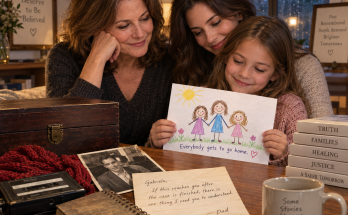
Valeria found a drawing she had made of our family.
Four stick figures.
Dad enormous.
Mom wearing a purple triangle dress.
Me with orange hair for reasons no one could explain.
Valeria held it up.
“Look.”
I did.
For a moment, Teresa was not a defendant.
She was the woman in the purple dress.
That did not erase anything.
It simply returned a piece of reality the investigation had flattened.
People are not born at the moment they harm you.
The next box contained Ernesto’s photographs.
Hundreds.
Some organized.
Most not.
Dad at the workshop.
Teresa pregnant with me.
Valeria asleep on his chest.
Birthday cakes.
Beach trips.
Christmas mornings.
A photograph of Teresa laughing so hard she had one hand over her mouth.
I had forgotten that laugh.
Or perhaps I had trained myself not to remember it.
Valeria sat cross-legged on the concrete floor.
“She was happy.”
“Sometimes.”
“I keep thinking that if she loved us, then what she did makes less sense.”
I sat beside her.
“Maybe love wasn’t the missing part.”
“What was?”
“Respect.”
She looked at me.
I thought of Mateo saying no over the red car.
Teresa had loved him.
She had also believed his refusal mattered less than her authority.
“Love without respect can still hurt people.”
Valeria nodded slowly.
We continued.
A box marked SERRANO surprised us.
Inside were copies of medical fundraising flyers for Mateo Gabriel Serrano.
Receipts.
Cards.
A photograph of the first Mateo with Ernesto.
Another of young Julián asleep in a chair beside his brother’s hospital bed.
I touched the photograph carefully.
Julián could not have been more than nine.
Rosalía had told us about those years.
Seeing them was different.
In another envelope, Ernesto had written a short note:
Mateo died today. Julián asked if being good makes people live longer. Told him no. Wish I had better answer.
I sat back.
Valeria read over my shoulder.
“That sounds like Dad.”
“Yes.”
No philosophy.
No false comfort.
Just a man wishing truth hurt less.
The account records were there too, but Samuel had already seen copies elsewhere.
Nothing changed the legal picture.
That was a relief.
We opened another carton.
Inside were things belonging to Julián.
His first employee badge.
An old baseball glove.
A technical-school certificate.
A broken watch.
“Why did Dad have these?”
Samuel pointed to an inventory sheet.
“Apparently Julián stored some belongings here when his mother lost her apartment.”
I remembered vaguely.
He had once told me he lost boxes during a move.
He had not lost them.
Ernesto had preserved them.
Near the bottom was a photograph of Julián at perhaps seventeen, holding the same blue toy car Mateo now kept beside the red one.
On the back:
Still runs badly. Keeping it anyway.
I laughed.
Of course.
I photographed it for Mateo.
Then we found a box labeled GIRLS — LATER.
Valeria groaned.
“That sounds ominous.”
It was not.
Inside were two envelopes.
One with my name.
One with hers.
We looked at Samuel.
He said, “Those are personal. You can read them here or take them.”
Valeria opened hers immediately.
I waited.
Her face changed as she read.
Then she laughed.
Then cried.
“What?”
She handed it to me.
Dad had written:
Valeria,
You think I don’t notice when you pretend not to care because caring makes you easier to disappoint. I notice.
She took the letter back.
“That man had no right to understand me.”
“He was your father.”
“Still rude.”
My envelope was thicker.
I opened it.
Clara,
You apologize before asking for things.
Stop.
I stared at the sentence.
Dad had noticed that too.
He wrote that I had always tried to predict everyone’s mood before speaking.
He did not blame Teresa.
Not directly.
He included himself.
Sometimes your mother and I made the house feel like weather you girls had to forecast. That was our failure, not your talent.
My eyes filled.
For years I had called myself observant.
Adaptable.
Good at reading rooms.
Some of that was skill.
Some was survival.
Dad knew.
He wrote:
When you have your own home, let people speak before they are certain how you will react.
I thought of Mateo.
The red car.
His question in the taxi.
Did I do something bad?
I folded the letter carefully.
Valeria leaned against me.
Neither of us spoke.
The storage unit contained no final confession.
No missing deed.
No explanation for every choice.
It contained something more useful.
Evidence that our family had existed outside its worst years.
We had birthdays.
Bad haircuts.
School plays.
Broken bicycles.
A father who noticed more than he said.
A mother who once laughed without calculation.
A young Julián who carried grief before I knew his name.
History did not need to be clean to belong to us.
Near noon, we reached the final box.
It contained home videos.
Actual tapes.
Samuel stared at them.
“Do either of you own a machine that plays these?”
“No.”
Valeria held one up.
“Archaeology.”
The labels covered years.
Christmas.
Beach.
Clara graduation.
Valeria dance recital.
Then one:
Mateo — hospital fundraiser.
The first Mateo.
I took it.
Another:
Julián — first job.
Another:
Clara + Julián wedding.
I smiled.
Our wedding video had disappeared after Teresa moved houses.
She claimed the tape was damaged.
It had been here.
Not destroyed.
Just misplaced inside Dad’s attempt to preserve too much.
We found a conversion service.
Two days later, digital copies arrived.
I watched the wedding video alone first.
Julián looked terrified at the altar.
I had forgotten.
His left hand shook.
When I reached him, I whispered something.
The microphone barely caught it.
“You look like you’re being arrested.”
He laughed.
That laugh.
I had not heard it in six years.
I stopped the video.
Then replayed five seconds.
Again.
Not because I wanted to live backward.
Because remembering someone’s voice is different from remembering their death.
Mateo watched later.
He sat absolutely still when Julián appeared.
“That’s Daddy?”
“Yes.”
“He moves.”
I laughed and cried at once.
“Yes.”
Photographs had made Julián seem frozen to him.
Now his father adjusted his tie.
Rubbed his nose.
Missed a step while dancing.
Spilled champagne.
Mateo laughed.
“Daddy was clumsy.”
“Sometimes.”
“Like me.”
“Sometimes.”
At the reception, Ernesto danced badly with Teresa.
She laughed.
Mateo pointed.
“Grandma looks different.”
“She was younger.”
“No. Her face.”
I knew what he meant.
She looked unguarded.
“People can be many things at different times.”
He considered that.
“Even bad and good?”
“People can do both.”
He watched quietly.
Then Teresa appeared holding my face between her hands before I left the reception.
The microphone caught her.
“My girl.”
I stopped breathing.
The tenderness was real.
So was everything that came later.
I did not need to choose which version counted.
Both did.
Mateo looked at me.
“Are you sad?”
“A little.”
“Want me to turn it off?”
The question almost undid me.
He was six.
And he was asking what I wanted instead of assuming.
“No. Keep it on.”
He pressed play.
A week later, Valeria and I finished sorting the storage unit.
We divided photographs.
Digitized letters.
Sent Serrano materials to Rosalía.
Saved copies for Mateo.
Donated tools.
Kept the red stool.
The bicycles were beyond repair, though Valeria argued hers deserved restoration on historical grounds.
I refused.
At the back of the unit, behind the rocking chair, we found one last object.
A small wooden sign from Ernesto’s workshop.
MAKE IT STRAIGHT BEFORE YOU MAKE IT PRETTY.
Valeria smiled.
“Dad.”
I took a photograph.
Then we hung it in my apartment kitchen.
It looked ridiculous.
I loved it.
That evening, Samuel called.
The parcel sale proceeds had cleared.
Restitution transfers were complete.
The property agreement had been recorded.
My share.
Valeria’s share.
Teresa’s reduced interest and occupancy rights.
Mateo’s trust restored.
Legally, the central financial dispute was finished.
“Finished?” I repeated.
“For now.”
“Lawyers should be prohibited from saying ‘for now.’”
He laughed.
Then his voice softened.
“Clara, you did well.”
I looked at the sign on the wall.
“No.”
“What?”
“We did accurately.”
That felt better than winning.
After the call, I opened the kitchen drawer.
Inside lay the repaired red car wheel we had replaced.
I had kept the broken original without knowing why.
I held it between two fingers.
That tiny piece of plastic had once seemed like the worst thing that happened at dinner.
Then blood appeared.
Then the hospital.
Then documents.
Trusts.
Forgery.
Inheritance.
Julián.
Ernesto.
Mariana.
Everything.
I put the wheel into a small envelope.
Not as evidence.
As memory.
On the front I wrote:
The night Mateo said no.
Then I placed it with the family photographs.
Not every object needed to be hidden.
Some simply needed their story attached.
Click here to continue reading: PART 26: Damián Finally Returned to the Dinner Room Where Mateo Was Hit, and One Small Choice Showed How Far the Family Had Changed
The Red Car Was the Only Thing Mateo Had Left of His Father, Until One Dinner Changed Everything
Part 25 of 27