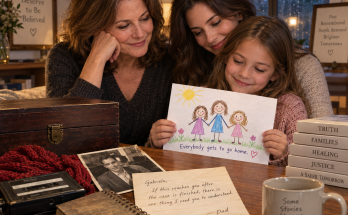
The kitchen looked exactly as it had the night my mother first saw Valeria on television.
The same table.
The same window.
The same worn cupboard.
Even the old kettle still rattled when it boiled.
But nothing about the room felt the same.
My mother held Valeria as though she were afraid that letting go might make the years return.
Valeria held her back.
Neither of them spoke.
Evelyn stood nearby with one hand over her mouth.
Jonah watched from the doorway.
Daniel stayed beside me.
For once, nobody needed to explain what had happened.
We all knew.
My mother had spent seven years believing her daughter was dead.
Now that daughter was standing in her kitchen.
Alive.
Older.
Changed.
But alive.
Eventually, my mother pulled away.
She touched Valeria's face.
“You look tired.”
Valeria laughed through her tears.
“So do you.”
My mother smiled.
“I've had seven years.”
“So have I.”
That sentence broke whatever restraint remained.
They both laughed.
It wasn't a perfect laugh.
It came through tears.
But it was real.
Later that evening, we ate dinner together.
Nothing special.
Soup.
Bread.
Rice.
Vegetables.
Daniel complained about the soup being too salty.
My mother told him to cook next time.
Jonah laughed.
Evelyn asked Valeria about the foundation.
Ordinary conversation.
The kind of ordinary life we had once thought impossible.
After dinner, I stepped outside.
The air was cool.
Valeria joined me.
“You know what I keep thinking?”
“What?”
“If the television broadcast hadn't happened, none of this would have happened.”
“Maybe.”
“Would you have wanted it another way?”
I thought about the question.
There was no good answer.
The truth had caused enormous pain.
But the lies had caused more.
“I don't know.”
She nodded.
“Neither do I.”
We watched the lights inside the house.
“My mother told me something tonight.”
“What?”
“She said she never stopped believing I was somewhere.”
“Even after seven years?”
“She said she stopped expecting to see me. That's different.”
I understood.
Hope did not always look like certainty.
Sometimes it was simply refusing to close the door completely.
The foundation grew during the following years.
We helped hundreds of families.
Some cases were solved.
Some remained open.
Some ended with difficult truths.
We never promised miracles.
We promised careful work.
That distinction became part of everything we did.
Valeria became the foundation's director.
Jonah handled records and genealogy.
Daniel worked with law enforcement on old identity cases.
My mother organized family support.
Evelyn created an oral-history project.
She recorded stories from people whose names had been altered or erased.
I managed the archive.
We kept copies of every document.
Nothing important existed in only one place.
That lesson had cost our family too much to forget.
The Ellis property records eventually became a teaching archive.
Researchers came to study them.
Law students reviewed the legal failures.
Historians examined the identity records.
Investigators used the documents to reopen old cases.
The family name became associated with wrongdoing for a while.
Some people wanted to erase the name.
Valeria refused.
“We don't erase history because it embarrasses us.”
She was right.
The truth had already taught us what erasure could do.
One afternoon, a young researcher asked her whether she hated the people responsible.
Valeria thought for a moment.
“I hated what they did.”
“Is that different?”
“Yes.”
“Why?”
“Because hatred of a person can become another way of refusing to understand what happened.”
She looked toward the archive.
“I want to understand.”
The researcher wrote that down.
Valeria smiled.
“Don't quote me.”
He laughed.
“I won't.”
She walked away.
Years later, I still remember that moment.
Not because it was profound.
Because it was ordinary.
She had become someone who could discuss the worst years of her life without allowing those years to define every day afterward.
Evelyn changed too.
She stopped calling herself a survivor.
She said she was a mother.
A daughter.
A grandmother.
A friend.
She learned that identity could be larger than the thing that had nearly destroyed it.
She visited Anna's grave every month.
Sometimes she brought flowers.
Sometimes she brought nothing.
Sometimes she simply sat.
The first time I joined her, she told me a story.
“Anna used to sing while she worked.”
“What did she sing?”
“I don't remember.”
She smiled.
“But I remember that she was happy.”
“Are you sure?”
“No.”
She looked at the stone.
“But I want to believe it.”
There was no evidence for that memory.
And perhaps that was okay.
Not everything meaningful needed to become a fact in an archive.
Some things belonged to the heart.
My father remained in prison.
He wrote occasionally.
He never asked us to forget.
He never described himself as a victim.
That mattered.
His letters became shorter over time.
One year, he sent only a postcard.
The front showed a tree in autumn.
On the back he wrote:
I spent my life trying to control what people knew. I should have spent it learning to trust them.
Valeria kept the postcard.
She didn't forgive him completely.
She didn't need to.
Forgiveness was never the requirement for healing.
Sometimes the most honest ending was simply acceptance.
Elias died before completing his appeal.
Vance testified until the end.
The remaining cases slowly closed.
Some families recovered property.
Others received compensation.
Some received nothing.
But many received something that had been missing for decades.
A name.
A record.
A confirmed answer.
That mattered.
The foundation's memorial wall eventually filled.
We built a second one.
Then a third.
Each carried names.
No categories.
No judgments.
Just names.
Because the first lesson our family had learned was that a missing person could disappear twice.
First from life.
Then from history.
We tried to prevent the second disappearance.
One spring morning, years after the first broadcast, I returned to the old kitchen alone.
The house had become a place we visited occasionally.
My mother had moved closer to the foundation.
Evelyn lived nearby.
Valeria had her own family now.
Children's drawings covered the refrigerator.
I stood beside the old cupboard.
I remembered the first time I had seen my mother praying there.
Seven years of whispered prayers.
Seven years of grief.
Seven years of believing there was nothing left to find.
Then I remembered the television.
The photograph.
Valeria's face.
The beginning of everything.
My phone rang.
It was Valeria.
“Where are you?”
“At the old house.”
“Come to the foundation.”
“Why?”
“I want to show you something.”
I drove there.
She was standing beside the memorial wall.
A new name had been added.
Anna Mercer.
Beneath it were three words.
Mother. Sister. Witness.
Evelyn stood beside her.
My mother was there too.
Daniel and Jonah were holding flowers.
Valeria handed me a photograph.
It showed all of us together.
Not as investigators.
Not as victims.
Not as people connected by a crime.
As a family.
“We should put this in the archive,” she said.
“Why?”
“So someone knows what happened afterward.”
I looked at the photograph.
That was the part people often forgot.
They remembered the disappearance.
The revelation.
The arrests.
The scandal.
But survival was not a single moment.
It was thousands of ordinary choices afterward.
Answering the phone.
Showing up for dinner.
Opening another file.
Listening to another family.
Visiting another grave.
Telling the truth when a lie would have been easier.
That was how we survived.
Not dramatically.
Daily.
My mother once told me that she had stopped praying for Valeria the day she came home.
I asked her why.
She smiled.
“I didn't stop praying.”
“What did you pray for?”
“That she would have a life.”
Valeria heard her.
She walked over.
“You got your wish.”
My mother touched her cheek.
“Yes.”
Then she looked at all of us.
“I got more than I asked for.”
The sun was beginning to set.
People were leaving the foundation.
The archive lights came on one by one.
Evelyn stood beside Anna's photograph.
Daniel was laughing with Jonah.
My mother and Valeria were arguing about where to eat.
It was the most ordinary scene imaginable.
And that was exactly why it felt extraordinary.
For years, our family had believed that the truth would destroy us.
It didn't.
The truth destroyed the version of our family built on silence.
What remained had to be chosen.
We chose each other.
Not because we were innocent.
We weren't.
Not because everyone deserved forgiveness.
They didn't.
Not because the past could be repaired.
It couldn't.
We chose each other because the past no longer had the right to decide who we would become.
I think about that whenever someone asks what happened after the television broadcast.
They expect another secret.
Another hidden room.
Another document.
Another person appearing at the door.
But there wasn't one.
The final revelation was much simpler.
My mother had not lost a daughter.
She had lost seven years with her.
Those years could never be returned.
But the years afterward belonged to them.
That was enough.
Valeria once told me that the strangest part of being found was realizing that everyone else had been searching for a version of her they remembered.
She had become someone else.
So had all of us.
We couldn't return to the people we had been before the broadcast.
Maybe that was the point.
The family that existed afterward was not the family that had existed before.
It was smaller in some ways.
Larger in others.
More honest.
Less certain.
But alive.
And whenever I see the photograph of Valeria on that television screen, I remember what my mother said that night.
She looked at the screen and whispered, “That's my daughter.”
Seven years of mourning ended with those words.
Not because the past disappeared.
Because, for the first time, the past could no longer decide what came next.
And that was the truth we had spent all those years trying to find.
Not who had lied.
Not who had disappeared.
Not who had ordered the first crime.
The truth was that a life could be stolen by secrets, but it could still be rebuilt through choices.
My mother chose to welcome her daughter home.
Evelyn chose to learn the truth about her mother.
Daniel chose to remember Clara for the courage she had shown rather than the secrets she had kept.
Jonah chose to reclaim the name that had been taken from him.
Valeria chose to help other families search for the people they had lost.
And I chose to keep the records.
Not because our family needed another secret keeper.
Because someone had to make sure the truth stayed where everyone could see it.
Years after the foundation opened, I still sometimes walk through the archive after everyone has gone.
The shelves are full.
The files are labeled.
The names are preserved.
The photographs are protected.
Nothing is hidden behind false walls.
Nothing is waiting beneath a floor.
There are no locked boxes that I know of.
And if there are mysteries left, we don't chase them simply because mysteries are exciting.
We follow evidence.
We respect uncertainty.
We let people tell their own stories.
That is the promise we made after everything ended.
The promise we kept.
My mother no longer prays for a dead daughter.
She calls Valeria every morning.
Usually, they argue about something ordinary.
Breakfast.
Appointments.
The weather.
Who forgot to call whom.
Sometimes my mother tells her she is working too much.
Sometimes Valeria tells her to stop worrying.
Sometimes they say nothing important at all.
And that is what makes those conversations precious.
They are not trying to recover seven years anymore.
They are simply living the years they have.
When I think about the story of our family now, I don't begin with the television broadcast.
I begin with the kitchen.
A mother watching a screen.
A daughter appearing where a dead woman was supposed to be.
A family realizing that grief had been built on a lie.
And I end with the same kitchen years later.
The kettle rattling.
People talking.
Someone laughing in the next room.
Valeria alive.
Evelyn home.
My mother no longer waiting.
The past finally documented.
The future finally ours.
That was the ending.
Not a mystery solved.
A life returned.
The End
Read more original stories on Feel Every Story.
The Face on the Television Was Supposed to Belong to a Dead Woman, Until She Spoke My Name and Changed Everything
Part 26 of 26