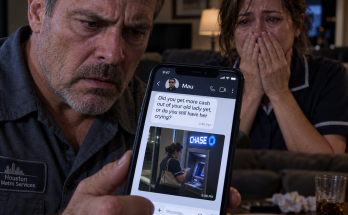
The financial investigators reconstructed my stolen money over the next two weeks.
They did it in spreadsheets.
I disliked spreadsheets now.
Too many terrible things had arrived in rows and columns.
Still, numbers do something memory cannot.
They refuse to become softer with retelling.
The total unauthorized money taken directly from my accounts was not eight thousand seven hundred dollars.
That was only what the bank representative found in the first review.
Once investigators traced linked withdrawals, bill-pay changes, reimbursement transfers, and a brokerage distribution I had not authorized, the total reached seventy-four thousand six hundred and twenty dollars.
Mitchell read the figure twice.
“I thought she tried forty-two.”
“She did,” I said.
“She already took seventy-four?”
“Over time.”
His face changed.
“How much came to us?”
Agent Reed had that answer.
Approximately thirty-one thousand dollars flowed into accounts used for Mitchell and Chloe’s household expenses.
Credit cards.
Travel.
Car payments.
A tax bill.
Home electronics.
Restaurant charges.
The rest moved through Chloe’s personal account, CW Strategy Group, cash withdrawals, and payments to Martin.
Mitchell looked physically ill.
“I benefited.”
Reed spoke carefully.
“Financial benefit does not automatically establish criminal knowledge.”
“I didn’t ask that.”
“No.”
“How much of my mother’s money paid my bills?”
“Roughly twenty-three thousand that we can identify directly.”
I watched my son absorb the number.
Twenty-three thousand dollars.
Not a theoretical inheritance.
Not money he might receive someday.
Money removed while I was alive and used to make his life easier.
“What did I buy?” he asked.
Reed opened the itemized tracing.
A credit-card payoff.
A weekend in Charleston.
Part of the down payment on Chloe’s SUV.
Several months of private loan payments.
A new television.
Mitchell looked toward my living room.
The television hanging above the fireplace had been purchased by Chloe the previous Christmas.
My Christmas present.
I almost laughed.
“Was that mine too?”
Reed checked.
“Yes.”
Margaret said, “That takes nerve.”
Mitchell closed his eyes.
The absurdity cut differently.
Chloe had stolen money from me and returned a fraction in the form of generosity.
I remembered thanking her.
She had hugged me.
“You shouldn’t have,” I had said.
Apparently I had been correct.
Mitchell stood and walked outside.
No one followed immediately.
Agent Reed continued because I asked him to.
Some money could likely be recovered from frozen accounts.
The forty-two-thousand-dollar attempted transfer had never left.
Approximately nineteen thousand remained in CW Strategy Group.
Evergreen had assets subject to seizure.
Martin surrendered additional funds.
Leonard’s accounts were partially frozen.
Full recovery was unlikely.
I discovered that losing money involved two separate injuries.
The first was the amount.
The second was how casually institutions said unlikely.
As if vanished retirement savings were a weather event.
Sarah filed civil claims alongside the criminal proceedings.
Banks had their own fraud investigations.
Insurance coverage might apply to some losses.
Restitution could eventually be ordered.
Everything required forms.
Of course it did.
By then I could joke about paperwork without hating every sheet.
Mitchell returned after half an hour.
He placed his car keys on the table.
“What are those?”
“My car.”
“I can see that.”
“I’m selling it.”
“Why?”
“Some of your money paid our debt while I was making payments on it.”
“That doesn’t make the car mine.”
“No.”
“Then why sell?”
“I want to repay you.”
I looked at Sarah.
She wisely said nothing.
“How much is the car worth?”
“Maybe thirty.”
“Do you need it for work?”
“Yes.”
“Then selling it and losing your job would be stupid.”
He almost smiled.
“What do you suggest?”
“I suggest you stop turning guilt into dramatic gestures.”
The smile disappeared.
“I’m serious.”
“So am I.”
I pointed to the chair.
“Sit.”
He did.
“You owe me something.”
“I know.”
“Not seventy-four thousand dollars.”
His brow tightened.
“What?”
“You owe me your share of what you knowingly did.”
“I knowingly signed the affidavit without reading it.”
“Yes.”
“I dismissed you.”
“Yes.”
“I let Chloe control your bills.”
“Yes.”
“I repeated things about your memory.”
“Yes.”
“I benefited from money I didn’t know was stolen.”
“That part matters differently.”
He waited.
“If you repay every stolen dollar yourself, you are claiming responsibility for Chloe’s theft.”
“I feel responsible.”
“Feeling is not accounting.”
That came from Arthur.
He used to say it when Mitchell confused regret with debt.
I continued.
“You will repay what is fair once we know what that means. Not because suffering makes you good.”
Mitchell stared at me.
“You sound like Dad.”
“I had decades of practice.”
Sarah finally spoke.
“We can structure restitution privately if Eleanor wants, but I strongly recommend waiting until the investigation identifies recoverable funds and Mitchell’s actual financial exposure.”
He nodded.
No argument.
Another small change.
Later that week, prosecutors interviewed Mitchell formally for almost six hours.
He disclosed everything.
The estate conversations.
The assisted-living discussions.
The affidavit.
His investment losses.
The debts.
Chloe’s explanations.
The times she corrected me in front of him.
The May dinner.
The day she asked him to sign documents.
He did not minimize.
His attorney advised precision, not self-destruction.
There was a difference.
Investigators concluded, provisionally, that they lacked evidence he knowingly joined the fraud.
The affidavit remained serious.
But deception surrounding his signature was corroborated by Chloe, Martin, message records, and document history.
No charges were filed against him at that stage.
When he told me, relief moved across his face.
Then shame followed immediately.
“You’re allowed to be relieved,” I said.
“I don’t feel like I deserve it.”
“Courts are not supposed to distribute suffering according to your mood.”
He rubbed his forehead.
“You always talked like this?”
“Apparently nobody listened.”
The criminal cases divided.
Martin negotiated first.
He agreed to cooperate against Chloe and Leonard and to assist investigators with prior victim cases.
His plea covered conspiracy, identity-related offenses, computer crimes, and financial exploitation.
He admitted building the digital infrastructure.
He admitted forging electronic documents.
He admitted accessing my banking profile without permission.
He admitted helping transfer the parcel.
He denied personally drugging anyone.
Prosecutors did not need him to admit everything to prove enough.
Leonard negotiated more stubbornly.
His attorney portrayed him as a disgraced professional pulled into schemes by younger, more aggressive participants.
Then investigators showed financial records from years earlier.
Helen Mercer.
Eugene Bell.
Other victims.
Leonard had been participating before Chloe’s company existed.
His victim story weakened.
He eventually admitted facilitating fraudulent or coercive transfers while disguising the transactions as family estate disputes.
That phrase made me furious.
Family estate disputes.
As though theft became less ugly when relatives were available to blame.
Chloe refused a plea at first.
Her attorney wanted to challenge whether the May drugging could be proved beyond her own court testimony and notebook.
Then prosecutors obtained the Martin recording.
He and Chloe were speaking two days after the dinner.
Her voice was unmistakable.
I almost screwed up with Eleanor. Used too much.
Martin replied, I told you not to touch her.
Chloe said, You told me we needed Mitchell convinced.
He answered, Not like that.
The recording ended.
Sarah did not let me listen twice.
Once was sufficient.
There was something strange about hearing yourself discussed as an object of calibration.
Too much.
Not enough.
Convincing.
Useful.
My body had become another variable in their paperwork.
The criminal charges against Chloe expanded to include offenses related to administering medication without consent, in addition to financial exploitation, identity fraud, forgery, computer-related offenses, conspiracy, and attempted theft.
I asked the prosecutor one question.
“Attempted?”
“The house and forty-two-thousand-dollar transfer were not completed.”
“The land was.”
“Yes.”
“So some charges involve completed offenses.”
“Yes.”
I appreciated exact language.
That had become important to me.
No exaggeration.
No convenient simplification.
Truth was strong enough.
Rose’s case advanced too.
The emergency guardianship review found substantial irregularities.
An independent physician evaluated her.
She had mild cognitive impairment.
Not severe dementia.
She could understand her finances and express consistent preferences with reasonable support.
That sentence made me cry.
Reasonable support.
Not control.
Not substitution.
Support.
Her nephew Caleb faced his own investigation.
The fraudulent property transfer was challenged.
Recovery remained complicated because the duplex had been sold to a third party.
Yet Rose gained something first.
Her legal voice.
The court modified the guardianship arrangement.
She moved out of secured memory care into an assisted-living apartment of her choosing while the property case continued.
Cecilia sent me a photograph.
Rose sat in a blue sweater beside a window holding a cup of tea.
The caption read:
She picked the room herself.
I stared at that sentence for a long time.
Choice.
So ordinary until someone takes it.
Ben came to visit me three weeks after Chloe’s arrest.
I saw his car from the porch.
He moved slower than I remembered.
So did I.
For several seconds we simply looked at each other.
Thirty years had happened to both faces.
Then he said, “You got old.”
“So did you.”
“I was handsome first.”
“You were tolerable first.”
He laughed.
Arthur’s laugh again.
That nearly undid me.
We sat under the oak tree.
Mitchell joined us later.
He barely remembered Ben, but family resemblance bridged some distance immediately.
Ben told him stories about Arthur I had forgotten.
Teenage fights.
A stolen motorcycle.
A fishing trip where Arthur fell through a rotted dock and denied being wet while standing waist-deep in water.
For one afternoon, the land existed without lawyers.
Then Ben became serious.
“I want something in writing.”
Mitchell stiffened.
I almost smiled.
“What?”
“That I claim nothing.”
Sarah had already prepared a disclaimer at his request.
Ben formally renounced any interest, historic or otherwise, in the parcel.
He acknowledged Arthur had settled their old financial dispute to his satisfaction.
He stated Chloe’s proposed declaration was false.
When he signed, he read every page.
Mitchell noticed.
“So everybody learned that lesson except Dad.”
Ben looked at him.
“Your father read everything.”
“I meant me.”
Ben nodded.
“Good. Shame works better when you can joke about it without escaping it.”
I liked him more at seventy-five than I had at forty-five.
Perhaps distance improves certain relatives.
The medical-company buyer returned with a new proposal.
One point five million dollars.
Higher than before.
Clean title, restored access rights, and surrounding development had increased urgency.
Sarah delivered the offer at my kitchen table.
Mitchell looked impressed.
Margaret whistled.
Ben said, “Arthur would be unbearable.”
They waited for me.
“What do you think?” Sarah asked.
I looked through the window toward the oak.
For months everyone had treated the land as money.
A target.
An inheritance.
A commission.
A percentage.
A solution.
Arthur had kept it because he believed it would become valuable.
He was right.
But value and price were not identical.
“What does the buyer want to build?”
“Access for the medical campus and related facilities.”
“Any environmental issues?”
“They’ll conduct studies.”
“Traffic?”
“Yes.”
“Jobs?”
“Likely.”
“Could we sell only what they actually need?”
Sarah smiled slightly.
“Yes.”
Mitchell leaned forward.
“You don’t want to sell the whole parcel.”
“I don’t know yet.”
The answer belonged to me.
That alone felt luxurious.
I asked for alternatives.
Easement sale.
Partial conveyance.
Long-term lease.
Access rights.
Development restrictions.
For the first time, decisions about my property were being discussed in front of me instead of around me.
No one rushed.
No one told me I was too old to understand.
No one used the phrase easier for you.
Several days later, the prosecutor called.
Chloe wanted to change her plea.
Not to everything.
Negotiations continued.
But she was prepared to accept responsibility for major financial and fraud charges.
Her attorney asked whether I would participate in a victim-impact process when sentencing eventually came.
I said yes.
Mitchell looked surprised.
“You want to speak to her?”
“No.”
“Then why?”
“I want to speak where she has to listen.”
That was different.
Before the case reached sentencing, however, investigators uncovered one final financial account.
A brokerage account in Chloe’s name.
Balance: one hundred twelve thousand dollars.
The money came largely from prior victim transactions.
Not mine.
But the account had a transfer instruction prepared for the week after my planned Oakmont admission.
Beneficiary account: Martin Hale.
Amount: three hundred fifty thousand dollars.
“Where would that money have come from?” I asked.
Agent Reed looked at the timeline.
“Your land sale.”
The distribution plan had been more specific than Leonard’s percentage note.
Once the 1.4-million-dollar deal closed, money would move through Evergreen and Ridgeway, pay fees and claims, then flow to Chloe’s company and onward.
But another instruction sat beneath it.
A second future transfer.
Two hundred thousand dollars.
To an account Mitchell recognized.
A joint account in his and Chloe’s names.
He stared.
“She was going to give me two hundred thousand?”
“Apparently.”
“Why?”
Reed had a message explaining it.
Chloe to Martin:
Mitch needs enough to think everything worked out and stop asking questions.
Martin replied:
Then leave.
Chloe:
After probate plan is set.
My skin prickled.
“Probate plan?”
Reed nodded.
“There’s another document.”
He placed it on the table.
A draft prepared by Chloe.
If I died after the land transfer but before house arrangements were completed, Mitchell would inherit under my existing will.
Chloe intended to remain married long enough to influence those assets.
Then leave.
The two hundred thousand dollars was not generosity.
It was anesthesia.
Money to keep my son comfortable while larger pieces moved elsewhere.
Mitchell sat silently.
Finally, he said, “She knew me.”
Nobody answered.
“She knew exactly what number would make me stop looking.”
I wanted to disagree.
I could not.
Then he pushed the document away.
“But she was wrong about one thing.”
“What?”
He looked at me.
“She thought I’d stay that person forever.”
The answer was not redemption.
Not yet.
But it was a choice.
And for the first time since the locks changed, I believed the ending of this story might depend less on what Chloe had planned than on what the rest of us chose to become after surviving it.