I had not thought about the land in nearly fifteen years.
Arthur and I bought the acreage in 1986 when the edge of the city still felt rural.
Twelve acres of red clay, scrub pine, and blackberry vines.
Arthur dreamed of building rental cottages after retirement. I wanted a garden large enough to grow tomatoes without squirrels stealing half of them.
Neither plan happened.
Life became more expensive.
Mitchell went to college.
Arthur’s mother became ill.
We sold the largest section to a developer and kept a narrow parcel along the back because Arthur disliked the price offered for it.
Later, I believed he sold that too.
Apparently, I had been wrong.
Detective Patel pulled up the county record on her tablet.
The parcel was 2.8 acres.
Owner: Eleanor Whitmore.
Transfer recorded eight days earlier.
Grantee: Evergreen Property Solutions LLC.
Consideration: ten dollars and other valuable consideration.
I stared at the screen.
“Ten dollars?”
Sarah answered.
“That wording is common on deeds. It doesn’t necessarily reflect the actual transaction.”
“Did I sell it?”
“No,” Detective Patel said. “That’s what we need to determine.”
“I did not.”
She nodded.
“Then we treat the transfer as potentially fraudulent.”
Mitchell read over her shoulder.
“I didn’t even know Mom owned this.”
“Neither did I,” I said.
The irony was almost unbearable.
Chloe had researched my property more thoroughly than I had.
Sarah asked for the deed image.
Detective Patel opened it.
There was my name again.
My forged signature.
The same notary.
The same neat imitation.
This one had not remained inside a locked drawer.
This one had been filed.
A crime had moved from preparation into action.
I touched the tablet screen lightly.
“What is the land worth?”
Nobody answered immediately.
That silence told me the question mattered.
Detective Patel said the county’s assessed value was just under ninety thousand dollars.
Mitchell whistled softly.
But Sarah was still reading.
“What?”
She enlarged the parcel map.
“This area has changed.”
“I know.”
A highway expansion had been announced several years earlier. Commercial buildings now stood where pastures once had.
Sarah looked at Detective Patel.
“We need a current appraisal.”
The detective nodded.
Mitchell pointed at the map.
“That distribution center they’re building—isn’t that just north of here?”
“Yes,” Sarah said.
Something shifted in her face.
“Which means this parcel may be significantly more valuable than the tax assessment.”
I remembered Arthur refusing an offer because he believed development would eventually reach the area.
“You’ll thank me when you’re eighty,” he had said.
I was eighty-one.
I almost smiled.
Then I remembered someone had stolen the land eight days before I learned I still owned it.
Detective Patel asked whether I had any old files related to the property.
I led them to the basement.
Arthur had kept records the way some men kept tools—carefully, excessively, and forever.
Four metal filing cabinets stood beneath the basement stairs.
The labels had faded, but I found LAND in the second drawer.
Inside were purchase contracts, survey maps, tax notices, and correspondence from developers.
The most recent document was fourteen years old.
It showed that Arthur had considered selling the remaining parcel.
He had never completed the sale.
Attached to the file was a yellow sticky note in his handwriting.
Keep this piece.
May be worth something later.
I sat down on the basement steps.
For a moment, nobody spoke.
Arthur had been gone almost nine years.
Yet there he was, in black ink, reaching across time with one small stubborn decision.
Margaret read the note over my shoulder.
“That sounds like him.”
“It does.”
I folded the paper carefully.
Sarah asked permission to copy the file.
I agreed.
Detective Patel called the county recorder.
Within an hour, an administrative fraud alert had been placed on the parcel while Sarah prepared legal action to challenge the transfer.
The property could not simply be restored by declaring the deed false.
There would be procedure.
Evidence.
Signatures.
Potential hearings.
Everything Chloe had counted on becoming too tiring for me to fight.
That afternoon, the appraiser Sarah contacted called back sooner than expected.
He knew the area.
He knew the parcel.
More importantly, he knew something none of us did.
A regional medical company had recently assembled surrounding land for a planned outpatient campus.
My 2.8 acres sat near the only practical access road.
“What does that mean?” I asked.
“It means,” he said carefully, “the land could be strategically valuable.”
“How valuable?”
“I won’t speculate without reviewing everything.”
“Speculate.”
He hesitated.
“Possibly several hundred thousand.”
Mitchell sat down.
Margaret muttered, “Good Lord.”
My mind returned immediately to Chloe.
She had not discovered some forgotten strip of worthless dirt.
She had discovered leverage.
Had she known about the development?
Sarah asked the same question.
Detective Patel opened her notebook.
“We find out.”
The answer came from the HOUSE folder.
Among the real-estate documents was an email from Martin to Chloe.
The message was brief.
Parcel is the real asset.
Need it moved before she catches on.
My stomach turned.
Another email, sent two weeks later, contained a map showing the proposed medical campus.
Martin had highlighted my property.
Mitchell read the message twice.
“He knew.”
“Yes,” I said.
“He knew exactly what it was worth.”
“So did Chloe.”
The next email confirmed that.
She wrote:
House first if possible. Land definitely. Once care placement is completed, objections become easier to manage.
I did not understand the last sentence.
Sarah did.
“If they successfully established that you lacked capacity, challenging prior transfers would become much harder for you personally.”
“So Oakmont wasn’t only about getting me out of the house.”
“No.”
“It was about weakening anything I said afterward.”
Sarah nodded.
That realization hurt differently.
Taking money was theft.
Taking property was theft.
But manufacturing a version of me whose objections could be dismissed—that was an attempt to steal my voice.
Mitchell walked out of the room.
I found him ten minutes later on the back porch.
He was sitting on the steps where Arthur once cleaned fish after weekend trips.
I lowered myself into the wicker chair.
For a while, neither of us spoke.
Finally, he said, “I helped them.”
“You helped Chloe.”
“I signed the affidavit.”
“Yes.”
“I told her about Dad’s estate.”
“Yes.”
“I told her you probably had everything in your name.”
“Yes.”
He pressed his fists against his forehead.
“I might have told her about the old land.”
I felt my body become still.
“When?”
“I don’t remember exactly. Months ago.”
“What did you say?”
“She was talking about investments. Real estate. We drove past that part of town. I mentioned Dad used to own property there.”
“Did you tell her we still owned some?”
“I didn’t know you did.”
“Did you tell her where the records were?”
He looked at me.
That was answer enough.
“Mitchell.”
“I told her Dad kept old property files in the basement.”
The grief on his face was real.
So was the consequence.
“I’m sorry.”
I looked across the yard.
Arthur’s oak tree leaves stirred in the heat.
“Sorry is the beginning of something,” I said. “Not the end.”
He nodded.
“I know.”
“Do you?”
“I’m starting to.”
I believed him.
That frightened me almost as much as distrusting him because belief would make future disappointment hurt again.
My phone rang.
Sarah.
Her voice was urgent.
“Eleanor, are you still with Mitchell?”
“Yes.”
“Put me on speaker.”
I did.
She had received information from Detective Patel.
The notary whose seal appeared on both forged documents was a real person named Denise Carver.
She worked at a shipping store across town.
The problem was that Denise denied notarizing anything for me.
Her notary stamp had been reported missing seven weeks earlier.
The timing matched almost perfectly.
“Who had access to the store?” Mitchell asked.
“Customers. Employees. Delivery contractors.”
“Martin?”
“Unknown.”
Sarah continued.
“There’s more.”
A security-camera review showed Chloe entering the store the afternoon the stamp disappeared.
Mitchell closed his eyes.
I asked the obvious question.
“Did she steal it?”
“They don’t have video showing the theft. Only that she was there.”
“Why was she there?”
“She mailed a package.”
“To whom?”
Sarah paused.
“Evergreen Property Solutions.”
Martin.
The sheriff’s department was preparing search-warrant requests connected to Martin’s business and Chloe’s financial accounts.
I listened without speaking.
The case was becoming larger than the house.
Larger than the forty-two thousand dollars.
Larger than Oakmont.
The planning had involved forged signatures, a stolen notary seal, unauthorized bank access, and an actual fraudulent land transfer.
When the call ended, Mitchell said, “She’s going to be arrested.”
“Maybe.”
He looked toward the driveway.
“She’s my wife.”
“I know.”
“I loved her.”
“I know that too.”
“Part of me still does.”
I considered that.
“Love does not disappear on schedule.”
He looked at me.
“Are you angry that I said that?”
“No.”
“Why not?”
“Because I spent months wanting to believe better things about you than the evidence justified.”
He absorbed the comparison.
Then his phone buzzed.
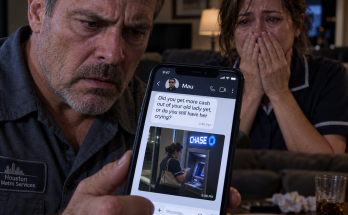
A text from Chloe.
He showed it to me.
We need to talk alone. I can explain everything. Don’t let your mother or her lawyer manipulate you.
Mitchell gave a short, bitter laugh.
Then a second message arrived.
Martin says there’s a way to fix this if you cooperate.
I felt the old fear rise.
“What does cooperate mean?”
Mitchell typed one word.
How?
Three dots appeared.
Disappeared.
Returned.
Then Chloe sent:
Tell them you knew about the transfers. Tell them Eleanor agreed to the land deal before her memory got worse. You’re her son. They’ll believe you.
Mitchell stared at the screen.
The request was breathtaking in its simplicity.
One more lie.
One more statement questioning my mind.
One more signature, perhaps.
This time, however, I was standing beside him when the choice arrived.
He looked at me.
Then he took a screenshot.
He forwarded it to Detective Patel.
Afterward, he blocked Chloe’s number.
“I should have done that months ago,” he whispered.
“No.”
He frowned.
“You should have asked questions months ago.”
He nodded slowly.
“That too.”
By early evening, the appraiser called again.
He had reviewed the planning maps.
His preliminary estimate placed my parcel somewhere between four hundred and six hundred thousand dollars, depending on access rights and development demand.
Margaret nearly dropped her coffee.
I felt no excitement.
Only clarity.
Four hundred thousand dollars explained why someone might forge a deed.
Six hundred thousand explained why someone might reserve an old woman a room behind secured doors.
The money did not create Chloe’s contempt.
But it had given that contempt a target.
Just before sunset, Detective Patel telephoned.
Officers had gone to Martin’s listed business address.
The office was empty.
Computers were gone.
File cabinets had been cleared.
And Martin’s vehicle was missing.
“Do you think he ran?” I asked.
“We don’t know yet.”
“Where is Chloe?”
“We’re trying to locate her.”
I looked at Mitchell.
His face told me the same thought had reached him.
Chloe had not simply driven to her sister’s house after leaving mine.
She and Martin might already be moving.
Detective Patel gave me strict instructions not to contact either of them and to call immediately if they appeared at the house.
Afterward, Mitchell checked his blocked messages.
One voicemail had been left before the block took effect.
He played it on speaker.
Chloe sounded breathless.
“Mitchell, listen to me. Martin is panicking. He has copies of everything, and if he thinks I’m blaming him, he’ll burn us both. I need you to call me before the police find him.”
The recording ended.
Mitchell stared at his phone.
I stared at the locked front door.
For the first time, Chloe sounded afraid.
Not of me.
Not of losing the house.
Of Martin.
And if the person who helped design the scheme was now frightened of her own partner, then whatever remained hidden was worse than what we had already found.
Click here to continue reading: PART 9: Chloe’s Voicemail Made Martin Sound Dangerous, but the Evidence He Left Behind Pointed to Someone With Even More to Lose
The Sunday I Replaced Every Lock, I Thought I Knew Exactly What My Daughter-in-Law Had Been Planning
Part 8 of 15