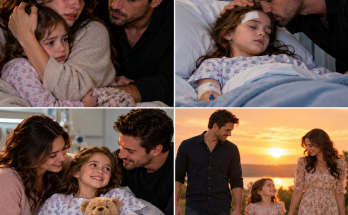
“I demanded the baby back. Bruno told me I was emotional. But the nurse gave her to me because I was the one who delivered her. After that, Bruno kept delaying. He said he needed the right time to bring her here.”
She looked at me.
“Last night, I found messages about transferring the baby to a private adoption contact. I told Bruno I would go to the police. He panicked. He said he would tell you today.”
I thought of the coffee.
The laxative.
His scream in the garage.
Some absurd part of me almost laughed.
I had thought I was ruining his romantic morning.
Instead, I had disrupted whatever plan had already been moving beneath our house.
“Why did he run?” I whispered.
My cousin looked at Bruno’s phone.
“Maybe the men arrived before you did. Maybe he escaped through the bathroom window.”
“And left his phone?”
“Panic makes people stupid.”
I thought of Bruno doubled over, sweating, furious.
For once, his body had betrayed him at the exact moment his lies collapsed.
The next morning, the DNA process began.
Emergency petition.
Court order.
Child protection involvement.
Medical review.
The fertility clinic denied everything at first.
Then my cousin arrived with police and document preservation orders.
Their attitude changed.
By afternoon, we had enough to prove that embryo records had been altered.
By evening, a nurse from the clinic called my cousin privately.
“I knew something was wrong,” the nurse said. “But Dr. Larios told us the wife had signed everything.”
The wife.
Me.
I had signed nothing.
At least nothing knowingly.
But in the file, there were consent forms with my name.
My signature.
Not mine.
My initials.
Not mine.
A copy of my passport.
A scanned ID from Bruno’s files.
All used to build a lie around my body.
My grief.
My embryos.
My child.
Lucía remained in temporary protective custody, but because Carolina had brought her to me and cooperated fully, she was allowed supervised contact.
So was I.
The first time a social worker placed Lucía in my arms, I almost collapsed.
She smelled like milk and baby shampoo.
Her head fit beneath my chin.
Her tiny hand opened against my blouse.
I looked down at her and saw, or imagined I saw, my mother’s mouth.
My own brow.
Bruno’s dark hair.
I wanted to love her immediately.
I did love her immediately.
But love arrived tangled with horror.
There is no clean way to become a mother through a crime.
Carolina sat across the room, crying quietly.
I did not comfort her.
Not then.
Lucía blinked up at me.
Her dark eyes unfocused but calm.
“Hello,” I whispered.
My voice broke.
“I think I’m your mother.”
The DNA results came five days later.
I opened them in my cousin’s office.
Carolina was there.
So was the social worker.
The report confirmed it.
Lucía was my biological daughter.
Bruno was her biological father.
Carolina was not genetically related.
The room blurred.
My cousin put a hand on my shoulder.
Carolina covered her face and sobbed.
I read the words again.
Probability of maternity: 99.999%.
My daughter.
My stolen daughter.
My hidden daughter.
My six-week-old baby who had almost been taken by strangers because the man I married believed women, wombs, babies, and truth were all things he could arrange around his convenience.
Bruno was arrested two days later at a cheap motel outside Puebla.
He had shaved his beard.
Dyed his hair badly.
Used cash.
He looked ridiculous in the police photo.
Smaller than I remembered.
Maybe he had always been small, and I had lent him height by loving him.
When he called from holding, I almost did not answer.
My cousin said I did not have to.
But I wanted to hear his voice without believing it.
“Mariana,” he said.
He sounded exhausted.
“Where is Lucía?” I asked.
Silence.
Then softly, “So Carolina told you.”
“She told me enough.”
“I was going to explain.”
I laughed.
That laugh came from somewhere ugly and necessary.
“When? After selling her? After bringing her here? After letting me thank you for making me a mother?”
“I was not selling her.”
“No?”
“No. It got complicated.”
“Babies are not business deals, Bruno.”
He inhaled shakily.
“I made mistakes.”
“You created a child behind my back using embryos I thought were safely stored. You deceived a desperate woman into carrying her. You forged my consent. You hid my daughter for six weeks. Then men came to my house to collect her.”
His voice lowered.
“I never meant for them to go to the house.”
That was not a denial.
My blood chilled.
“Who are they?”
No answer.
“Who is M?”
Still nothing.
“Bruno.”
His voice cracked.
“I owed money.”
The floor seemed to tilt.
“What?”
“Investments went bad. Loans. Men you don’t just ignore.”
I closed my eyes.
The expensive dinners.
The missing savings.
The strange withdrawals.
The hotel rooms.
The perfume.
All of it had looked like an affair.
But beneath the affair was debt.
And beneath the debt was my daughter.
“They found out about the embryos,” he whispered. “They knew a private adoption network. They said people would pay.”
I pressed the phone so hard against my ear it hurt.
“You were going to sell our child?”
“No!” he cried. “I was trying to fix it. I was going to bring her to you. Once you saw her, you would help me. You would pay anything.”
There it was.
The real confession.
Not love.
Not regret.
Calculation.
He thought my motherhood would become his ransom note.
I hung up.
The trial became news.
Of course it did.
A stolen embryo.
A secretary surrogate.
A missing husband.
Men breaking into a house in Del Valle.
A baby almost sold through a private network.
Reporters camped outside.
Neighbors stared.
Women online argued about Carolina.
Some called her a victim.
Some called her a homewrecker.
Both things could be true in different proportions.
That was the part people hated.
They wanted clean roles.
Villain.
Victim.
Mother.
Mistress.
But real life is more uncomfortable.
Carolina had betrayed me.
She had also been exploited.
She had carried my daughter safely.
She had brought Lucía to my door instead of handing her to the men.
I did not know what forgiveness would look like.
But I knew the truth required all its pieces.
In court, Bruno tried to say I had agreed to everything and later “forgot” because of emotional distress.
That lasted until my cousin played the messages.
Until the clinic nurse testified.
Until Carolina testified.
Until the financial records showed debts, payments, forged consents, and contact with illegal brokers.
Until Bruno’s own call from jail was entered.
“You would pay anything.”
The prosecutor repeated that line three times.
Each time, Bruno looked smaller.
Carolina testified for two days.
She cried through most of it.
At one point, Bruno’s lawyer tried to paint her as a jealous mistress who had invented the baby scheme after being rejected.
Carolina looked at him and said, “I loved a man who lied to me. That made me foolish. It did not make those documents fake.”
I looked at her then.
Really looked.
For the first time without only hatred.
She was twenty-six.
Tired.
Ashamed.
Still lactating for a baby she no longer had in her arms every night.
A woman who had made terrible choices and then, when the final choice came, had chosen to bring Lucía to me.
That mattered.
Not enough to erase.
Enough to remember.
Bruno was convicted on multiple charges.
Fraud.
Forgery.
Reproductive coercion.
Child trafficking conspiracy.
Assault-related charges tied to the men who broke into my house.
The clinic doctor lost his license and faced separate proceedings.
The private adoption network cracked open wider than anyone expected.
Several babies were found.
Several women came forward.
Several families learned truths that broke and remade them.
Lucía, without knowing it, had pulled a thread that unraveled an entire hidden industry.
She was nine months old when the custody order became final.
I became her legal mother.
Sole guardian.
No contact with Bruno.
Carolina requested one thing through the court.
Not custody.
Not rights.
A letter.
One letter placed in Lucía’s file for when she was old enough.
I read it first.
It began:
Dear Lucía, I carried you before I understood the truth. When I learned enough to be afraid, I chose the door that led to your mother. I am sorry for every choice that made your beginning painful. I hope one day you know that even inside a lie, you were loved by more than one woman.
I cried for an hour after reading it.
Then I approved it.
Carolina moved away from Mexico City.
She sent updates through my cousin for a while.
Her father recovered.
Her brother graduated.
She never contacted me directly.
I appreciated that.
Bruno sent letters from prison.
I did not read them.
My cousin kept them in a file.
Evidence, if needed.
Trash, emotionally.
Lucía grew.
She laughed before she crawled.
She hated peas.
She loved music.
She had a stubborn little frown that looked unfortunately like Bruno, but I learned not to fear it.
Children are not their fathers’ crimes.
One day, when she was two, she found the black coffee cup in the back of a cabinet.
Best husband.
I had forgotten to throw it away.
She banged it against the floor until the handle broke.
I laughed so hard I cried.
Then I threw it away.
For a long time, I blamed myself.
For not reading every fertility form.
For trusting Bruno.
For turning my suspicion into a laxative joke instead of going to the police sooner.
For not knowing my daughter existed.
Therapy helped.
So did motherhood.
Babies are very rude to guilt.
They need bottles, diapers, songs, clean blankets, vaccines, sleep routines, and someone willing to look ridiculous making airplane noises with mashed banana.
Guilt can wait its turn.
Years passed.
Lucía learned to walk in the living room where men had once broken glass.
I replaced the window.
I replaced the table.
I replaced the locks.
I replaced my last name.
Back to Torres.
Mine.
My mother’s.
One evening, when Lucía was four, she asked why there were only pictures of her as a baby after she was already big enough to smile.
I sat very still.
The question had come earlier than I expected.
Children find locked doors by accident.
I touched her hair.
“Because when you were very tiny, Mommy didn’t know where you were yet.”
She frowned.
“Was I lost?”
I swallowed.
“A little.”
“Did you find me?”
I looked at her.
At those dark eyes.
At the child who had been hidden from me, carried by another woman, nearly taken by strangers, and delivered to my door wrapped in yellow.
“Yes,” I said. “You came home.”
She seemed satisfied.
For now.
One day, she will know more.
Not everything at once.
Not before her heart can hold it.
But she will know.
I will tell her that she was not born from shame.
She was born through a crime, yes.
Through lies, yes.
Through betrayal, yes.
But she herself was never the betrayal.
She was the truth everyone tried to move around.
The living proof.
The heartbeat that refused to remain hidden.
I will tell her that a young woman named Carolina made terrible mistakes but carried her safely and chose not to hand her to danger.
I will tell her that her father broke laws, vows, and bodies of trust, and that he faced consequences.
I will tell her that motherhood did not begin for me in a hospital room.
It began at my own front door, when a woman I hated stood there pale and shaking with a baby in a yellow blanket.
It began in terror.
It became love.
Sometimes I still think about that morning.
The perfume.
The coffee.
The little bottle in my hand.
Bruno swallowing without gratitude.
His scream from the garage.
The absurd satisfaction I felt when he ran to the bathroom.
I thought I had made him swallow his shame.
I had no idea shame was only the smallest thing in that house.
Behind it were forged papers.
Stolen embryos.
Debt.
A baby hidden in another woman’s arms.
Men waiting outside doors.
A life I had dreamed of, born in secret while I was mourning it.
I once believed betrayal was the worst thing a husband could do.
I was wrong.
Betrayal can break a marriage.
But stealing a woman’s chance to know her own child?
That breaks the world.
And yet, somehow, from that broken world came Lucía.
My daughter.
My miracle with dark hair and a laugh like bells.
The child who taught me that truth can arrive wrapped in the arms of someone who hurt you.
That love can begin with terror.
That motherhood is not always clean, but it can still be sacred.
And that sometimes, the doorbell you dread most is the one that brings your life back.
Bruno left that morning perfumed for his lover.
He thought he was going to choose between two women.
He thought he was the secret-keeper.
The father.
The man in control.
But by nightfall, his phone was on the floor, his lies were in a folder, police were in my living room, and the baby he tried to use as leverage was asleep in my arms.
The coffee had only delayed him.
The truth destroyed him.
And Lucía?
She saved me.
Part 3: The Girl in the Photograph
I couldn’t breathe.
The photograph trembled in my hands.
A little girl stared back at me.
She looked about five years old.
Dark hair.
Dark eyes.
The same stubborn expression Lucía made whenever she refused to eat vegetables.
On the back, written in black marker, were the words that haunted me for weeks:
SHE’S ASKING ABOUT HER MOTHER.
“Where did this come from?” I whispered.
My cousin looked grim.
“It was hidden in Bruno’s storage locker.”
The room spun.
I looked down at Lucía sleeping peacefully in her crib.
Then back at the photograph.
Another child.
Another stolen life.
Possibly another daughter.
And somehow Bruno had been connected to her.
The next morning, I couldn’t stay home.
I drove straight to the prosecutor’s office.
The photograph sat on the table between us.
“Tell me everything.”
The lead investigator opened a file.
“We didn’t want to discuss this until we verified it.”
My stomach tightened.
“Verified what?”
He slid several documents toward me.
One contained embryo transfer records.
Another contained bank statements.
A third contained surveillance photographs.
Then he pointed to a name.
Isabella Flores.
Age: 5.
Current location: Unknown.
My heart stopped.
“Who is she?”
The investigator hesitated.
Then answered.
“We believe she’s your biological daughter.”
The words hit harder than any punch.
I felt my body go numb.
I had spent years grieving children I thought would never exist.
Now someone was telling me I might have two daughters.
One sleeping safely at home.
One missing.
Somewhere.
Alone.
Growing up without knowing me.
Without knowing the truth.
That night I couldn’t sleep.
Every sound made me jump.
Every shadow looked like a threat.
At 3 a.m., my phone rang.
Unknown number.
I almost ignored it.
Almost.
But something told me not to.
I answered.
“Hello?”
Silence.
Then a tiny voice.
A little girl’s voice.
“Are you my mommy?”
The phone slipped from my hand.
My entire body froze.
I picked it up again with shaking fingers.
“What did you say?”
The child sniffled.
“Grandma says moms don’t leave their children.”
Tears exploded from my eyes.
“Sweetheart… what’s your name?”
A pause.
Then:
“Isabella.”
I collapsed onto the kitchen floor.
The child began crying.
Real crying.
The kind that comes from loneliness.
Not tantrums.
Not fear.
Abandonment.
“Mommy,” she whispered.
“Why didn’t you come get me?”
The question shattered me.
Because how could I explain?
How could I tell a five-year-old that someone had stolen her before I even knew she existed?
That every birthday she’d celebrated had happened without me.
That every scraped knee.
Every nightmare.
Every first word.
Had happened while I searched for a life I thought I had lost forever.
“Baby,” I sobbed.
“I’ve been looking for you.”
Then the line went dead.
Gone.
Just like that.
I stared at the phone.
The call had lasted less than two minutes.
But it changed everything.
Because now I knew one thing.
Isabella was alive.
And somehow…
She knew my number.
The police traced the call.
Three hours later they arrived at my house.
The investigator looked more serious than I’d ever seen him.
“We found where the call originated.”
“Where?”
He swallowed.
“A private children’s home.”
Relief flooded me.
Until he added:
“It burned down six months ago.”
The relief vanished instantly.
“What?”
“The records were destroyed.”
I stared at him.
“No.”
“There is one thing, though.”
He placed a photograph on the table.
Another photograph.
This one showed a woman standing beside Isabella.
An older woman.
Maybe sixty.
Silver hair.
Sharp eyes.
And around her neck hung something that made my blood run cold.
A necklace.
One I recognized instantly.
My mother’s necklace.
The one buried with her years ago.
I felt the room tilt.
Impossible.
Absolutely impossible.
My mother was dead.
Yet somehow her necklace had appeared beside the little girl.
The investigator looked pale.
“We don’t know what it means.”
I did.
Or at least I thought I did.
Because suddenly a memory surfaced.
Something my mother once told me.
A family secret she’d taken to her grave.
A secret about a daughter.
A daughter nobody ever spoke about.
A daughter who disappeared decades earlier.
My aunt.
The missing sister nobody could find.
The woman my grandparents pretended never existed.
The woman who would now be nearly sixty years old.
The same age as the woman in the photograph.
I looked at Isabella.
I looked at the necklace.
And I realized the nightmare was far bigger than Bruno.
Far bigger than the clinic.
Far bigger than the trafficking network.
Because someone from my own family might have been involved.
Someone who had been hiding in the shadows for decades.
Someone who knew exactly who Isabella was.
And exactly where she had come from.
The investigator leaned forward.
“Mariana.”
His voice was barely above a whisper.
“We found something else.”
“What?”
He handed me a DNA report.
I read the first line.
Then the second.
Then the third.
My hands began shaking.
Because the report didn’t identify Isabella as my daughter.
It identified her as—
To Be Continued… 😱🔥
Part 4: Mariana discovers a family secret buried for thirty years, and the DNA report reveals a truth even more shocking than the stolen embryos.
Part 4: The DNA Report
My hands trembled so badly that the paper nearly slipped from my fingers.
The investigator reached out as if he thought I might faint.
I barely heard him.
I was staring at a single line on the report.
A line that made no sense.
A line that should have been impossible.
Relationship Probability: 99.998%
Subject: Isabella Flores
Relationship to Mariana Torres: Half-Sister
I blinked.
Then read it again.
And again.
Half-sister.
Not daughter.
Not niece.
Not cousin.
Sister.
My legs gave out beneath me.
“No…”
The word escaped my lips before I could stop it.
The investigator slowly nodded.
“We ran the test three times.”
“That’s impossible.”
“We thought so too.”
I looked at the photograph again.
The little girl.
The silver-haired woman.
The necklace.
Everything suddenly felt wrong.
Twisted.
Like pieces of a puzzle being forced together.
My mother had died when I was twenty-three.
She had been fifty-eight.
How could I have a five-year-old sister?
How?
Then another memory surfaced.
A memory I hadn’t thought about in years.
I was ten years old.
My mother was cleaning out an old closet.
A photograph had fallen from a box.
A picture of a newborn baby.
I remembered asking who it was.
And I remembered my mother’s reaction.
The fear.
The panic.
The way she snatched the picture from my hands.
Then locked it away.
That night I overheard my parents arguing.
My father shouting.
My mother crying.
And one sentence that never made sense until now.
“We promised never to speak about her again.”
The next morning, I visited my grandmother’s old house.
The house had been empty for years.
Dust covered everything.
The silence felt heavy.
Like the walls were hiding secrets.
I spent hours searching.
Old drawers.
Old cabinets.
Boxes stacked in the attic.
Then I found it.
A locked wooden chest hidden beneath loose floorboards.
My heart pounded.
Inside were dozens of letters.
Most were addressed to my mother.
But one stood out.
A yellow envelope.
Never opened.
My mother’s handwriting covered the front.
I tore it open.
Inside was a letter dated thirty years earlier.
And as I began reading, my world shattered.
“María,”
“If you are reading this, then I have finally run out of time.”
“There is something you were never supposed to know.”
“The baby survived.”
I stopped breathing.
My eyes raced across the page.
“Your father paid the hospital to declare her dead.”
“He believed another child would destroy our family.”
“So they took her away.”
“But she lived.”
“And I have spent twenty-five years searching for her.”
The paper slipped from my hands.
I stared into empty space.
The missing daughter.
My mother’s lost child.
The secret nobody spoke about.
The sister who disappeared.
She had never disappeared.
She had been stolen.
And suddenly everything clicked.
The woman in the photograph.
The silver-haired woman.
The one wearing my mother’s necklace.
The one standing beside Isabella.
She wasn’t my aunt.
She wasn’t a stranger.
She was my mother’s first daughter.
My sister.
A knock on the front door startled me.
I jumped.
Nobody should have known I was there.
Slowly, I walked toward the entrance.
Another knock.
Three sharp taps.
My pulse hammered.
I opened the door.
And nearly collapsed.
Standing on the porch was the woman from the photograph.
The silver-haired woman.
The woman who looked so much like my mother it hurt.
For several seconds neither of us spoke.
Neither of us moved.
Then tears filled her eyes.
And she whispered four words.
“Hello, little sister.”
I couldn’t breathe.
Thirty years.
Thirty years of lies.
Thirty years stolen from both of us.
And now she was standing right in front of me.
Real.
Alive.
Looking at me as if she had spent her entire life searching for this moment.
Then she said something that made my blood run cold.
Something far worse than anything Bruno had ever done.
Something that explained why Isabella had my phone number.
Why she had called me.
Why someone had hidden her.
The woman looked over her shoulder.
Making sure nobody was nearby.
Then she leaned close and whispered:
“They’re watching us.”
My stomach dropped.
“What?”
Her face turned white.
“The people who took Isabella.”
Silence.
Then:
“They took my daughter too.”
And at that exact moment, a black SUV slowly rolled past the house.
Its windows were completely dark.
The vehicle stopped.
Just for a second.
Long enough for the driver to look directly at us.
Then it drove away.
But not before leaving a single envelope in the mailbox.
An envelope with no stamp.
No address.
Only three handwritten words: