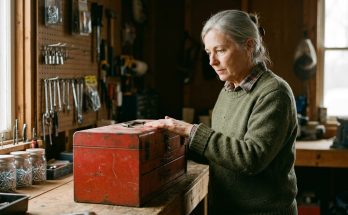
Celia Ward did not want to return.
That was the first thing Ramirez told us.
She would speak by video.
She would provide records.
She would identify people.
But she would not travel back to the county unless compelled.
Ruth understood immediately.
“I wouldn’t come back either.”
Celia’s interview lasted most of a day.
Investigators confirmed pieces through old employment files, photographs, tax records, and messages she had saved.
The picture that emerged stretched years before Marissa met Kurt.
Celia had worked as an office manager for a small construction supplier.
Kurt worked nearby.
Dean Mercer did occasional contracting jobs.
Paul Vance was already a police officer.
Their connections were not secret.
They drank together sometimes.
Helped one another with jobs.
Loaned vehicles.
Nothing obviously criminal on the surface.
Then equipment began disappearing.
Small items first.
Power tools.
Generators.
Copper wire.
Building materials.
Celia noticed invoices that did not match inventory.
She asked questions.
Her supervisor told her not to worry.
She kept asking.
That was when Kurt began paying attention to her.
“What did he do?” Ruth asked.
Ramirez chose her words carefully.
“He ingratiated himself.”
“Meaning?”
“He became helpful.”
The answer made me cold.
Of course.
Control did not always begin with threats.
Sometimes it began with favors.
He fixed Celia’s car.
Carried boxes.
Helped when her sister needed a ride.
Brought food when money was tight.
Then he learned things.
Debts.
Family problems.
Arguments.
A custody dispute involving Celia’s niece.
He remembered all of it.
Months later, when Celia discovered evidence suggesting stolen property was being moved through company storage, she confronted Dean.
Not Kurt.
Dean.
That was her mistake.
“Dean told Kurt?” I asked.
“According to Celia.”
“What happened?”
“Kurt warned her to stop.”
“Did she?”
“No.”
I almost smiled.
Then Ramirez continued.
“He started following her.”
The smile disappeared.
Her tires were slashed.
Someone broke into her apartment but took nothing.
Anonymous complaints were made to her landlord.
Her sister received calls claiming Celia was unstable.
One night, Celia found a note under her windshield wiper.
WE KNOW WHERE NORA SLEEPS.
Nora had been a child.
Ruth covered her face.
“That’s why Celia taught her the arrows.”
“Yes.”
Celia began creating emergency routes.
She used blue painter’s chalk because the supply warehouse had boxes of it.
Blue marks identified doors, windows, and hiding places.
She taught Nora that if something felt wrong, follow blue toward an exit.
The system was never meant to become permanent.
Then Celia learned other women around Kurt had similar stories.
Not identical.
But familiar.
Threats.
Leverage.
Secrets.
Evidence kept in strange places.
People persuaded they were too compromised to seek help.
“She went to police?” I asked.
“Yes.”
“Vance?”
“No. Another officer.”
I leaned forward.
“What happened?”
“She gave a statement.”
“And?”
“The investigation went nowhere.”
“Why?”
“That’s being reviewed.”
“Did Vance touch it?”
“His name appears in internal correspondence.”
Ruth laughed bitterly.
“Of course it does.”
Again Ramirez corrected her.
“We do not yet know what he did.”
But Celia did.
Or believed she did.
According to her, Vance approached her privately after she spoke to police.
He told her she was making dangerous accusations.
He suggested stolen property might be found in her own car if she continued.
She left town within two weeks.
“What about the warehouse fire?” I asked.
“That happened three months later.”
“Celia thinks Kurt set it?”
“She suspects the fire destroyed records.”
“Can that be proved?”
“Not yet.”
The original fire investigation had identified an electrical fault.
Nothing in the reopened records immediately disproved that.
Again, suspicion was not evidence.
But the blue-arrow cabinet from the fire scene had belonged to Celia.
Inside it, she said, were copies of inventory records.
Those records disappeared in the fire.
“Did she have duplicates?”
“Yes.”
Ruth stared.
“Where?”
“Outside the county.”
Celia had learned the same lesson Sadie eventually learned.
Never keep only one copy.
The records did not prove abuse.
They documented financial irregularities, property movements, and names.
Some matched Kurt’s later notes.
Some matched Dean’s business records.
One name appeared repeatedly.
Paul Vance.
The investigation expanded again.
By now, I had stopped thinking of it as a circle.
It was a web.
Kurt at the center of some strands.
Dean in others.
Vance touching points where help might otherwise have entered.
Women and children moving around the edges, each seeing only part.
Celia had seen the earliest structure.
Nora inherited the survival method.
Sadie inherited it from Nora.
And somehow a blue line had traveled seven years to my back patio.
At school, Emma was becoming impatient with secrecy.
“Why can’t Sadie tell me everything?”
“Because some things are private.”
“She tells me things.”
“Some things.”
“I’m her best friend.”
“That doesn’t entitle you to all of her pain.”
Emma did not like that answer.
I made her sit with it anyway.
“She can tell you if she wants.”
“What if she doesn’t?”
“Then you still get to be her friend.”
“That seems unfair.”
“To whom?”
Emma thought.
Then sighed.
“Okay.”
I was learning alongside her.
Caring about someone did not create a right to details.
Sometimes love was accepting the closed door without rattling the handle.
That afternoon, Sadie came home from school with Emma for the first time since the sleepover.
Officially.
Not hidden.
No investigator waiting.
No emergency plan.
Just two backpacks dropped by the stairs.
The normality was so intense I almost cried.
“Snack?” I asked.
“Yes,” Emma said.
“No, thank you,” Sadie said automatically.
Then she stopped.
Her eyes went to the pantry.
“Actually, yes.”
Another tiny change.
“What do you want?”
“Anything.”
“That is not a useful category.”
She smiled.
“Crackers.”
I put a plate between them.
Sadie ate without wrapping anything for later.
I noticed.
I pretended not to.
Later, while they worked on homework, a loud crash came from outside.
Sadie dropped her pencil.
Her whole body went rigid.
Emma looked at her.
A trash bin had tipped over in the wind.
I expected Emma to say it was nothing.
Instead she waited.
Sadie walked to the window.
Checked.
Returned.
Picked up the pencil.
No apology.
No explanation.
Progress did not look dramatic.
It looked like a child verifying danger and continuing afterward.
That evening, Ruth came to get her.
“She had a good day,” I said.
Ruth smiled.
“She has more of them now.”
“Not all.”
“No.”
We stood near the door while Sadie tied her shoes.
“She had a nightmare last night.”
I looked at Ruth.
“About Kurt?”
“She wouldn’t say.”
“Does she have to?”
“No.”
Ruth shook her head.
“I finally understand that.”
A few days later, Celia agreed to let investigators share one specific message with Nora.
The message was simple.
The blue arrows were never supposed to become your job.
Nora cried when she read it.
When Sadie eventually heard a similar version through her therapist, she asked a question.
“Then whose job was it?”
The adults around her struggled with the answer.
Because the honest response was not one person.
Parents.
Teachers.
Doctors.
Police.
Social workers.
Family.
Neighbors.
Institutions.
Each had a role.
None alone could guarantee safety.
But the burden had never belonged to Sadie.
That became part of her therapy.
So did another exercise.
She made two columns.
Mine.
Not mine.
Under Mine:
My feelings.
My words.
My body.
My room at Grandma’s.
Waffles.
School.
Choosing when I hug people.
Under Not Mine:
Kurt’s choices.
Mom’s choices.
Police.
Court.
Lily being safe.
Grandma being sad.
Other kids.
The last line took her longest.
Other kids.
Ruth told me Sadie stared at it for almost five minutes.
“She still thinks she has to save everyone,” Ruth said.
“After what happened, that makes sense.”
“I know.”
“Doesn’t mean she should.”
“I know that too.”
Legal developments moved slowly.
Kurt was formally charged on multiple counts.
The exact allegations were broader than the public initially understood.
Some concerned Sadie.
Some concerned other children.
Some involved evidence and obstruction.
Dean faced separate charges.
Vance remained under investigation and was later arrested on charges related to misconduct and evidence handling.
His attorney denied wrongdoing.
Kurt’s attorney continued to challenge searches and witness credibility.
Nothing was final.
Trials had not happened.
Facts would be argued in court.
Ramirez reminded us repeatedly not to confuse charges with convictions.
That mattered.
Even when emotionally we had already crossed the distance between suspicion and certainty, the legal system could not.
Marissa’s status remained the most complicated.
She was charged with offenses related to failing to protect Sadie and assisting Kurt in concealing certain evidence.
At the same time, prosecutors acknowledged evidence that she had been coerced and abused.
The public hated ambiguity.
Comment sections filled with demands.
Lock her up forever.
She’s innocent too.
Worst mother alive.
Victim.
Accomplice.
Monster.
People wanted a category.
Sadie did not.
When Ruth gently told her that Marissa was facing legal consequences, Sadie asked only one thing.
“Can she still be my mom?”
Ruth cried after that conversation.
“She doesn’t mean custody.”
“I know.”
“She means the word.”
“I know.”
The answer, of course, was yes.
Legal decisions could define contact.
Responsibility.
Placement.
Consequences.
They could not retroactively erase a relationship.
Sadie was allowed to write Marissa letters through approved channels.
The first one was only six sentences.
Ruth did not read it.
That mattered too.
Weeks passed.
The blue chalk faded completely from my patio.
Emma redrew it.
Sadie laughed when she saw.
“You made the arrows crooked.”
“They still work.”
“For what?”
“Coming back.”
The phrase had become theirs now.
No longer an emergency code.
A friendship joke.
One Friday, I drove them to school.
As Sadie opened the car door, she paused.
A girl I did not know was standing near the entrance crying.
Her father was crouched beside her.
Sadie watched.
For a second, I saw the old alertness return.
The impulse to assess.
To intervene.
To carry.
Then she looked at me.
“Someone else is helping her.”
“Yes.”
Sadie nodded.
She got out of the car.
That small decision stayed with me.
She had seen distress.
She had recognized it.
And she had allowed another adult to be responsible.
Maybe that was healing too.
That afternoon, Ramirez called with an update on Celia’s old records.
Investigators had matched several transactions to assets recovered from 17C and Dean’s property.
The evidence strengthened financial and conspiracy aspects of the broader case.
But another discovery mattered more personally.
Inside one of Celia’s archived folders was a photograph from seven years earlier.
A company picnic.
Kurt.
Dean.
Vance.
Celia.
Several other employees.
And in the background, almost hidden behind a table, a young Marissa.
Ruth stared at the image.
“She knew Kurt before she said she did.”
Ramirez nodded.
“How much earlier?”
“That’s what we’re determining.”
Ruth’s face tightened.
“Did Marissa lie again?”
“Possibly.”
“Why?”
“We don’t know.”
The photograph was dated nearly a year before Marissa claimed she first met Kurt.
When confronted, Marissa changed her statement.
Again.
She said she had forgotten.
Then she admitted she had not forgotten.
She had been protecting one final secret.
Kurt had not discovered her theft by accident after they met.
He had been involved before it happened.
And according to Marissa, he was the person who first suggested she take the money.
Click here to continue reading: PART 16: Marissa’s Final Secret Revealed Kurt Had Manufactured the Crime He Later Used Against Her, Changing the Meaning of Every Choice She Made Afterward
The Only Girl Who Would Not Leave Her Shoes Beside the Door Was Watching Me for a Reason
Part 15 of 28