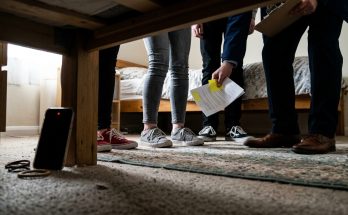
The Hudson Yards condominium closed under court supervision three weeks after the Plaza launch.
Not because the sale completed normally.
Because investigators and attorneys needed to establish what Michael had purchased, with whose money, and what remained inside.
The unit was still technically held by the LLC.
The deal had progressed farther than Maya understood.
Michael had made deposits.
Signed financing documents.
Ordered furniture.
Paid designers.
He had been preparing a home.
Or a stage set for one.
Maya did not want to go.
Neither did I.
Then Rebecca discovered that invoices associated with the condo referenced a secure storage installation.
That changed things.
Investigators obtained legal authority to search the premises.
I was not invited.
Maya was not invited.
For once, that was a relief.
Ruiz called Sarah afterward.
They found records.
Lots of them.
A locked room had been built behind a concealed panel in what the floor plan labeled a study.
Not dramatic secret passage architecture.
Just expensive cabinetry hiding a reinforced door.
Inside were filing boxes, encrypted drives, two laptops, and a small fireproof safe.
Michael had built physical redundancy.
He did not trust clouds alone.
Bell spent days cataloging the material.
The first findings confirmed what we already knew.
Trust documents.
Northline records.
Investor statements.
Forged authorizations.
Property schedules.
Then they found the ledger.
Handwritten.
Michael’s handwriting.
A notebook containing dates, initials, amounts, and repayment targets.
Rebecca called it a shadow reconciliation ledger.
Unlike the official records, it tracked what Michael believed he owed each source.
Dalton.
Other investors.
Crescent.
Our marital accounts.
Even me.
A.D. exposure.
The number beside my initials was $684,300.
I stared at it.
“What is that?”
Rebecca answered carefully.
“His estimate of funds derived from assets connected to you.”
Nearly seven hundred thousand dollars.
Our savings.
Borrowing against our home.
Investment accounts.
Profits associated with unauthorized trades.
The number was not necessarily legally accurate.
But it mattered because Michael wrote it.
He knew.
He had quantified what he took from the financial life we built together.
Maya’s initials appeared too.
M.J. equity obligation: $312,000.
Her promised share.
Her unpaid compensation.
Her condo interest.
Again, Michael priced betrayal.
But the ledger contained something unexpected.
Every major obligation had a repayment source listed.
For Dalton: M&M future revenue.
For smaller investors: portfolio exits.
For Crescent: Northline distribution.
For me: property + retirement offset.
For Maya: equity conversion.
Michael had not written “keep.”
He wrote “replace.”
That distinction did not absolve him.
But it explained the machinery.
He had built a system around the fantasy that missing money was temporary.
He intended to repay everyone someday.
Someday became the moral loophole.
At the bottom of one page, he had written:
No losses permanent if time available.
I read the sentence aloud.
Sarah’s expression was grim.
“That may be the central lie he told himself.”
Time.
Michael believed time could convert wrongdoing into repair.
If the investments recovered, no one was harmed.
If M&M succeeded, investor money returned.
If I accepted property, marital funds balanced.
If Maya retained equity, emotional damage became compensated.
If Dalton waited, redemption could be covered.
Everything would become acceptable later.
He had treated consequences like bridge financing.
The safe contained cash.
Not millions.
Eighty-six thousand dollars.
Several passports were not there.
Only Michael’s expired one.
His active passport remained with investigators after his voluntary interview.
So he had not been preparing an international escape in the simplest sense.
The one-way London ticket had been something else.
Bell found correspondence.
Michael had scheduled a meeting in London with a prospective buyer for M&M’s client book.
A desperate sale.
If completed, he expected proceeds large enough to cover Dalton’s immediate redemption and part of Northline’s deficit.
“He wasn’t fleeing?”
I asked.
Ruiz answered.
“We cannot characterize intent.”
Of course.
But the records suggested London was another attempted fix.
Not escape from consequence.
Escape through transaction.
Sell something.
Buy time.
Repeat.
The buyer had canceled after hearing about the Plaza launch disruption.
That explained why Michael canceled the ticket.
Another door closed.
Then came the most important discovery.
One encrypted drive contained a spreadsheet called FULL GAP.
Bell obtained access after Michael’s attorney provided decryption information as part of continuing cooperation.
The spreadsheet listed every known deficit.
Total missing or misallocated funds at peak exposure:
$2.46 million.
My breath stopped.
Not all currently missing.
Some had been repaid.
Some remained invested.
Some recovered through market gains.
Some sat frozen.
The present unreconciled gap was smaller.
But still enormous.
More important, the document included source categories.
The original Kessler-directed loss.
Later investor substitutions.
Michael’s personal trading losses.
Marital borrowing.
Business transfers.
Property.
It separated them.
For the first time, investigators could distinguish the first wrongdoing from everything Michael added afterward.
Kessler’s role was significant.
Michael’s independent choices were larger.
That mattered to me more than I expected.
Not because I needed Michael to be uniquely guilty.
Because I needed the beginning not to become an excuse for everything.
He had been pressured.
Then he had chosen.
Again.
Again.
Again.
Until choice became habit.
One row in FULL GAP caught my attention.
A.D. margin gains historically retained household.
I frowned.
“What does that mean?”
Rebecca explained.
Those early unauthorized margin trades had made money.
Some profits entered our shared finances.
Vacations.
Down payment.
Home improvements.
I felt sick.
“So I benefited.”
“You received household benefit without knowledge of the unauthorized activity.”
“That still means some of our life came from it.”
“Yes.”
I looked at Sarah.
“Does that make me involved?”
“No.”
The answer was immediate.
“Knowledge matters. Authorization matters. Intent matters.”
“But money is money.”
“And law is not moral contamination by contact.”
Her phrasing stopped me.
I had begun doing exactly what Michael predicted.
Turning everything inward.
What should I have noticed?
What had I benefited from?
What did that make me?
The answer was less dramatic than guilt wanted.
It made me someone deceived by a person with access.
That did not erase complexity.
It located responsibility correctly.
Maya faced a similar problem.
Her attorney informed her that some salary and business expenses had been paid from commingled funds.
She called me that evening.
“I bought furniture with money from M&M.”
“You were paid for work.”
“What if investor money was in that account?”
“You didn’t know.”
“That feels too easy.”
“It isn’t easy. It’s just accurate.”
She was quiet.
Then said, “You sound like Sarah.”
“Terrifying.”
We both laughed.
Our laughter no longer felt disloyal to what happened.
It felt like evidence that Michael no longer controlled the emotional temperature of every room.
Two days later, investigators found the final folder in the condo.
Personal.
Not finance.
Letters.
Some addressed to me.
Some to Maya.
None sent.
Michael had written them during the past year.
I did not immediately agree to read mine.
Ruiz said they were not necessary for the financial case unless I chose to review copies released through counsel.
I waited three days.
Then asked for them.
The first letter was dated eleven months earlier.
Allison,
I keep telling myself I will fix the accounts before I tell you, because if the numbers are whole again then maybe the lie becomes smaller.
I stopped reading.
Not because it hurt.
Because the logic was so clear now.
Make the numbers whole.
Make the lie smaller.
Another letter, six months later:
You still trust me with things I no longer deserve to touch.
That sentence nearly broke me.
He knew.
Awareness had not produced change.
A later letter:
I think you would survive leaving me better than you would survive learning what I used your name for.
Again, that distorted protection.
He believed controlling my discovery was mercy.
One final letter was dated two nights before my first day at TechSphere.
It was longer.
He wrote that Maya loved him.
That I loved him.
That he had become incapable of distinguishing responsibility from fear.
That M&M was supposed to repair the financial damage.
That if the company succeeded, he intended to repay every diverted dollar, divorce me “cleanly,” and marry Maya after enough time had passed that the timelines would seem less cruel.
I sat with that sentence for several minutes.
Divorce me cleanly.
As though deceit could become clean if scheduled properly.
Then the letter reached the photograph.
I gave Maya the Maui picture today. Allison took it. I know how grotesque that sounds written down.
My chest tightened.
He continued:
I think part of me wants the worlds to touch because I am too weak to bring them together myself.
There it was.
Not a sophisticated trap alone.
Not pure strategy.
Self-sabotage.
A controlled accident.
He wrote:
If Allison sees it, everything begins. If she doesn’t, I still have time.
Time again.
Always time.
The last line read:
I no longer know whether I am arranging discovery or asking to be stopped.
I put the letter down.
Sarah sat across from me.
“What are you thinking?”
“That he knew exactly what he was doing.”
“Yes.”
“And also didn’t.”
She waited.
“He designed it. But he also wanted something outside himself to end it.”
“That happens.”
“I don’t forgive him.”
“No one asked you to.”
“I understand him more.”
“That is not the same thing.”
I looked toward the window.
Understanding had once frightened me because I thought it might weaken anger.
Instead, it made the betrayal sharper.
Michael was not a mystery anymore.
He was a man who repeatedly recognized his own wrongdoing, postponed correction, and built increasingly elaborate systems to postpone it further.
That afternoon, Sarah received notice of formal charges being prepared.
The details remained sealed.
We did not know timing.
We did not know which counts would survive.
We did not know how prosecutors would divide responsibility among Michael, Jonathan, Kessler, and others.
But one practical decision could no longer wait.
The divorce petition.
Sarah placed the final draft before me.
For weeks, divorce had been entangled with evidence.
Strategy.
Asset preservation.
Investigations.
Now the document looked almost ordinary.
Marriage date.
Residence.
Property.
Grounds.
Relief requested.
A legal ending measured in numbered paragraphs.
I signed.
My real signature.
Slowly.
Deliberately.
Sarah watched without speaking.
When I finished, I looked at the ink.
It was mine.
That mattered more than anyone else in the room could understand.
For years, Michael had treated my name like something he could deploy when needed.
Now I used it for the first decision he could no longer rearrange.
The petition would be filed that afternoon.
Maya texted while I was leaving.
How are you?
I answered:
I signed.
She knew what I meant.
Her reply came a minute later.
Good.
I stood on the sidewalk outside Sarah’s office.
The day was cold and clear.
No rain.
No hidden message.
No unknown number calling.
Just traffic.
People walking.
A delivery cyclist arguing with a taxi driver.
Ordinary life refusing to recognize private catastrophe.
For months Michael had planned my dissolution like a financial event.
Target date.
Exposure.
Mitigation.
Settlement.
But he had never planned this version.
One where the timing belonged to me.
One where Maya walked away.
One where Dalton spoke.
One where Jonathan cooperated.
One where investigators found the ledger.
One where the photograph succeeded in exposing him far beyond what he intended.
Michael had wanted an affair to trigger a manageable divorce.
Instead, he had opened the door to every room he spent years keeping locked.
Click here to continue reading: PART 17: The Divorce Filing Took One Signature, but Michael’s Response Revealed He Still Believed Their Marriage Could Be Used to Control the Case
On My First Morning at TechSphere, a Photograph Beside a Stranger’s Keyboard Made Seven Years of Marriage Suddenly Uncertain
Part 16 of 24