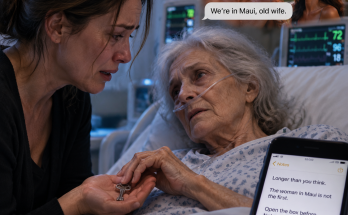
On my thirtieth call to Nolan, his mother stopped breathing properly. One moment Evelyn was staring at me from the hospital bed, frightened but alert; the next her fingers clamped around mine and her chest began making a thin, laboring movement that looked nothing like breathing. I dropped my phone onto the blanket and reached for the call button. “Evelyn? Look at me.” Her eyes found mine, but they seemed to be looking through a great distance. The monitor beside her accelerated into a sharp electronic rhythm. A nurse came running before I could press the button twice.
They moved me into the corridor while three people crowded around the bed. Through the open door I saw a respiratory therapist adjusting oxygen and a doctor leaning over Evelyn with his stethoscope. I stood against the wall with Nolan’s unanswered call still glowing on my screen. Thirty attempts in less than two hours. Thirty chances for my husband to learn that his mother might die that night. He had answered none of them.
Nolan had told me he was in Chicago for an investment conference. He had left three days earlier carrying the dark leather overnight bag I had given him for our fifteenth anniversary. That afternoon he had texted that meetings were running late and he would probably be unreachable. Under ordinary circumstances I would have accepted that without another thought. We had been married twenty years. I knew his travel habits, his preferred hotels, the way he switched his phone to silent during negotiations. I had spent half my life learning not to interpret his absences as rejection.
But this was not ordinary. Evelyn had collapsed in her kitchen shortly after six. I had found her because she failed to answer our usual evening call. When I drove over, her front door was unlocked and a pot of soup was burning on the stove. She was on the floor beside the breakfast table, conscious but too weak to stand. In the ambulance she kept asking whether Nolan knew. I told her I would reach him.
I believed it when I said it.
The doctor finally stepped into the corridor and pulled his mask down. He had the careful expression physicians use when there is no kind way to arrange the facts. Evelyn’s heart was failing. They had stabilized her, but he could not promise how long that would last. She was eighty-one, medically fragile, and exhausted. “If there are close family members who need to be here,” he said, “I wouldn’t wait until morning.”
I looked at the phone in my hand.
“I’ve been trying her son.”
“Keep trying.”
Those two words carried more weight than he intended.
I walked to the window at the end of the corridor. Rain had begun streaking the glass, turning the parking-lot lights into pale smears. I called Nolan again. It rang six times before going to voicemail.
“Nolan, this is Claire. Your mother is very sick. The doctor says you need to come home. Please call me.”
I stopped, then added, “Please don’t make her wait for you.”
I ended the call and immediately regretted the last sentence. Nolan hated what he called emotional pressure. During arguments he could take one frightened sentence and examine it until I was apologizing for the way I had spoken instead of remembering what had upset me. I could already imagine him saying I was being dramatic.
For years, that possibility had been enough to make me soften my words.
That night I no longer cared.
When the nurse let me return, Evelyn looked smaller beneath the hospital blankets. Her gray hair had come loose around her temples, and the oxygen tubing pressed against the fragile skin beneath her nose. I pulled the chair close and sat.
“Did you find him?” she asked.
“Not yet.”
She looked toward the door.
“He knows you’re here,” I said quickly. “I’ve left messages.”
Her mouth tightened. “Thirty?”
I blinked. “What?”
“You called thirty times.”
“How did you know?”
A strange expression crossed her face. “You told me before they took you outside.”
I had no memory of telling her. Perhaps I had. The evening had become a collection of disconnected images: the burnt soup, ambulance lights on wet pavement, Evelyn’s cold fingers, the unanswered phone.
She watched me carefully. “Call once more.”
“I will.”
“No.” Her hand moved weakly over the blanket until it reached mine. “Now.”
Something in her tone made me obey.
I dialed Nolan for the thirty-first time and put the phone to my ear.
One ring.
Two.
Three.
On the fourth, someone answered.
Relief came so quickly that I nearly laughed. “Nolan?”
There was a pause.
Then a woman said, “Hello?”
I pulled the phone away and stared at the screen. NOLAN MERCER. I had not dialed the wrong number.
“Who is this?” I asked.
Another pause, shorter this time.
“Who’s this?”
“My name is Claire Mercer. This is my husband’s phone.”
Nothing.
Behind me, Evelyn shifted in the bed.
I heard sounds through the phone that did not belong in a Chicago conference room. Water. Distant music. A door sliding open or closed. Then the woman breathed out slowly, as though she had just realized she was standing on the edge of something.
“Claire,” she said.
The fact that she knew my name frightened me more than her answering Nolan’s phone.
“Where is my husband?”
“He’s not here right now.”
“Where is here?”
“I really think you should talk to Nolan.”
“I’ve tried talking to Nolan thirty-one times.”
She said nothing.
“His mother may be dying.”
A small sound escaped her. “Oh.”
“Where are you?”
“I can’t—”
“Where?”
The woman lowered her voice. “Maui.”
For several seconds I heard nothing except my own breathing.
“Maui?”
“Yes.”
“Nolan told me he was in Chicago.”
“I’m sorry.”
There are moments when a marriage does not break loudly. There is no shattered plate, no screaming, no slammed door. Sometimes twenty years simply rearrange themselves around one quiet sentence spoken by a stranger.
I looked toward Evelyn.
Her eyes were closed.
“Are you there with him?” I asked.
“Yes.”
“In the same room?”
The woman did not answer.
I did not need her to.
“What is your name?”
She hesitated. “Vanessa.”
“How long have you known my husband?”
“Claire, please. You need to ask him.”
“I am asking you because he won’t answer me.”
“I shouldn’t have picked up.”
“No. You should have. It may be the first honest thing anyone has done for me tonight.”
Vanessa went silent.
I heard a door open on her end.
A man’s voice said something too far from the phone for me to understand.
Vanessa inhaled sharply.
Then Nolan’s voice became clear.
“Who are you talking to?”
The call disconnected.
I remained sitting with the phone against my ear.
Evelyn opened her eyes.
I lowered my hand.
“He’s in Hawaii,” I said.
She did not ask why.
That registered slowly.
I studied her face. “Evelyn?”
She looked away.
A chill moved through me that had nothing to do with the hospital’s air-conditioning.
“You knew.”
“No.”
“You didn’t look surprised.”
Her fingers tightened around the blanket.
“Did you know about Vanessa?”
“I didn’t know her name.”
I stood so abruptly that the chair legs scraped the floor.
“You knew there was someone?”
Evelyn closed her eyes.
“How long?”
“Claire.”
“How long have you known?”
She opened her eyes again, and what I saw there was not embarrassment. It was grief.
“Long enough to be ashamed that I didn’t tell you.”
I walked to the window because I could not remain beside her. Outside, rain hammered the glass. My reflection looked unfamiliar: damp hair, pale skin, coat still marked where I had knelt on Evelyn’s kitchen floor.
“You let me sit at your table,” I said. “You let me talk about him. You listened while I defended his trips.”
“I was trying to understand what he was doing.”
“He was cheating.”
“That isn’t what I mean.”
I turned.
Evelyn was struggling to sit higher.
“Don’t.” I moved automatically to help her, then stopped myself. Anger and concern collided inside me so hard that neither could settle. “What do you mean?”
“Nolan has secrets that have nothing to do with another woman.”
I stared at her.
She glanced toward the closed hospital door.
“What secrets?”
“Come closer.”
I almost refused. Then I remembered the doctor saying she might not have until morning.
I returned to the chair.
Evelyn reached beneath the edge of her blanket. Her fingers trembled as they worked at something hidden near her hip.
“What are you doing?”
“Help me.”
I lifted the blanket.
A narrow cord had been tied around her waist beneath the hospital gown.
Attached to it was a tiny silver key.
I looked at her.
She untied the cord and pressed the key into my palm.
It was old and unexpectedly heavy, its teeth darkened with age.
“What does this open?”
“Something Nolan has been looking for.”
My anger disappeared beneath a colder emotion.
“Why?”
“Because he knows what happens if you find it first.”
I closed my fingers around the key.
“Find what?”
Evelyn looked toward the door once more.
Then she leaned close enough that I felt her breath against my cheek.
“The proof.”
“Proof of the affair?”
Her eyes met mine.
“No.”
The monitor ticked steadily beside us.
“Then proof of what?”
Evelyn swallowed with difficulty.
“Of what your husband has really been doing to you.”
Click here to continue reading: PART 2: The Woman Who Answered Nolan’s Phone Was Only the First Secret His Dying Mother Had Been Hiding From Me
While Evelyn Fought for Breath, My Husband Ignored Thirty Calls and Left Me Facing the Worst Night Alone
Part 1 of 24