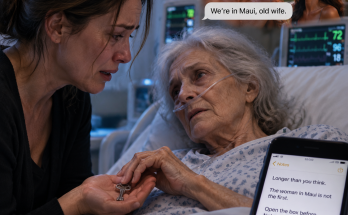
Julian laughed when I told him.
Not because it was funny.
Because the alternative was apparently disbelief.
“J.C.?”
“Yes.”
“You think that means me?”
“I think it is a question.”
“I was fourteen when Thomas died.”
“I know.”
“So unless I had an unusually productive middle-school career, no.”
Despite everything, I smiled.
“Do those initials mean anything to you?”
His humor vanished.
“Yes.”
My pulse quickened.
“Who?”
“Jonathan Cross.”
I stared.
“Your father?”
“Yes.”
Of course.
Another family.
Another inherited silence.
“Why didn’t you mention him before?”
“Because I didn’t know this had anything to do with him.”
“What did he do?”
“He was an engineer.”
“With Thomas and Elliot?”
“Apparently.”
“That sounds important.”
“It would have if I’d known.”
“Did your father know Thomas?”
“Yes.”
“You never told me that.”
“You never asked.”
I almost laughed from exhaustion.
“Please do not become Eleanor.”
“That bad?”
“Worse.”
His voice softened.
“My father died when I was twenty-six.”
“I’m sorry.”
“He and Thomas had been friends years before.”
“How close?”
“I don’t know.”
“Did Adrian know?”
“Yes.”
My stomach tightened.
“How?”
“That’s how Adrian found me.”
I went still.
“What?”
Julian sighed.
“We met after he contacted me about old technical papers.”
“Thomas’s notebooks.”
“Yes.”
“So Adrian didn’t just recruit you because you were talented.”
“No.”
“He found the son of one of his father’s collaborators.”
“Yes.”
“And you never thought that mattered?”
“I thought he wanted someone who understood the technical history.”
“Did he tell you Jonathan helped build the prototype?”
“No.”
“What did he say?”
“That our fathers had discussed systems architecture.”
I closed my eyes.
Another half-truth.
“Did Jonathan leave papers?”
“Yes.”
“Where?”
“In storage.”
“Julian.”
“I know.”
“When can we see them?”
“I can get them today.”
Marcy insisted the retrieval be documented.
No private searching.
No selective production.
Julian agreed.
By afternoon, two storage boxes sat inside Marcy’s conference room.
Jonathan Cross had preserved almost everything.
Invoices.
Diagrams.
Conference programs.
Technical drafts.
And one spiral notebook.
On the first page were three names.
Thomas Vale.
Elliot Mercer.
Jonathan Cross.
Underneath:
Prototype ownership: equal thirds until incorporation.
I stared at the sentence.
“Equal thirds.”
Dad read it again.
Julian sat across from me looking stunned.
“That changes everything.”
Marcy raised a hand.
“It changes evidence. Legal conclusions come later.”
Julian almost smiled.
“You really do say that every time.”
“Yes.”
We continued.
The notebook contained dated entries.
Tasks divided among the three men.
Thomas handled commercial design.
Elliot financing models and predictive logic.
Jonathan systems architecture.
Not one visionary.
Three.
The mythology behind Vale Strategic Holdings began collapsing line by line.
I thought of Adrian’s interviews.
“My father had an idea before his time.”
Technically true.
Incomplete enough to become fiction.
“Did Adrian ever see this notebook?” I asked Julian.
“No.”
“You’re sure?”
“It was in my father’s storage.”
“Could he have told Adrian about it?”
“My father died before I met Adrian.”
“Did you ever tell Adrian there were boxes?”
“No.”
“That may be the first piece of old evidence he genuinely didn’t know existed.”
Julian looked almost relieved.
Then Dad found an envelope.
Addressed to Jonathan.
From Elliot.
Inside was a proposed incorporation agreement.
Three equal founders.
Unsigned.
“Why didn’t they incorporate?” I asked.
Julian turned pages.
“Here.”
A later note.
Thomas wants majority control. Elliot refuses. Jonathan wants technical veto. Meeting ended badly.
I leaned back.
Three men.
One idea.
Too much pride.
Not enough paperwork.
A conflict capable of surviving them all.
“What happened after?” I asked.
Julian continued reading.
“Jonathan withdrew.”
“When?”
“Six months before Elliot and Thomas split.”
“Did he give up his rights?”
“No document here.”
“Was he paid?”
Dad found a ledger.
“Ten thousand.”
“To Jonathan?”
“Yes.”
“For what?”
“Consulting closeout.”
Marcy frowned.
“That may or may not address ownership.”
We searched for hours.
At five, we found a letter from Jonathan to Elliot.
I am walking away from the business, not pretending I did not build part of it.
My pulse quickened.
“What does that mean legally?”
Marcy gave me a look.
“I know.”
“Good.”
“Evidence first.”
“Exactly.”
Julian sat very still.
“My father never told me.”
“Why would he?”
“I don’t know.”
He looked at the notebook.
“He spent my whole childhood telling me not to mix friendship and business.”
I almost laughed.
“So everyone’s parents turned unresolved trauma into life advice.”
Dad looked at me.
“That sounds uncomfortably accurate.”
By evening, one possibility had become unavoidable.
Vale’s foundational technology might descend from work jointly created by three men whose rights were never cleanly resolved.
Thomas had possession of the notebooks.
Elliot had attempted a transaction that was never completed properly.
Jonathan had withdrawn operationally without clear assignment.
Decades later, Adrian commercialized a modern version.
And Julian helped him do it without knowing his own father might have held historical rights.
“That’s insane,” Julian said.
“No,” Marcy replied. “It’s ordinary.”
We all looked at her.
“Families leave things unresolved. Businesses start anyway. People die. Documents disappear. Then success makes old ambiguity valuable.”
That explanation was more frightening than conspiracy.
Nobody needed to plan a generational scheme.
They only needed to keep postponing clarity.
Dad closed the notebook.
“What does this mean for Vale now?”
“Experts.”
“I know.”
“Historical technical comparison. Chain of title. Statutes. Assignments. Incorporation documents.”
“And emotionally?”
Marcy looked at him.
“I don’t bill for emotionally.”
For the first time that day, everyone laughed.
Briefly.
It helped.
Then my phone rang.
Helen Ward.
I answered.
“Mara, I heard there are additional historical records.”
“That travels fast.”
“Julian told the board.”
I looked at him.
He nodded.
Good.
No more private truths.
“What do you need?”
“Nothing yet.”
“Then why call?”
“Because Adrian resigned publicly this morning.”
“I saw.”
“And lenders want assurance the company has a path to clean ownership.”
“Does it?”
“That depends partly on your family.”
I stiffened.
“No.”
“Mara—”
“Do not turn this into another situation where Vale survival becomes our obligation.”
“I’m not.”
“Then explain.”
“If Elliot’s estate has a viable claim, we need to know whether your father is willing to negotiate rather than litigate.”
Dad held out his hand.
I put the call on speaker.
He spoke.
“Helen.”
“Mr. Mercer.”
“I have no interest in destroying Vale.”
“Thank you.”
“That is not a promise to waive anything.”
“Understood.”
“Nor an admission there is anything to waive.”
“Understood.”
“What I will promise is good-faith process once experts establish facts.”
Helen exhaled.
“That’s enough.”
Dad looked at me.
“See?”
“What?”
“People can ask without assuming entitlement.”
I smiled despite myself.
Julian spoke.
“My father’s estate will do the same.”
Helen went quiet.
“Julian?”
“Yes.”
“I didn’t know.”
“Neither did I.”
She sighed.
“Of course not.”
After the call, something strange happened.
For the first time since the restaurant lunch, a problem became collaborative without becoming manipulative.
No one demanded rescue.
No one implied love created obligation.
Facts would be examined.
Rights negotiated.
Responsibility assigned.
It was almost startlingly simple.
Then Adrian arrived.
He had been invited by Marcy only after the board confirmed he remained a relevant witness despite resigning.
He entered and saw Jonathan’s notebook.
His face changed.
“What is that?”
Julian answered.
“My father’s.”
Adrian looked at him.
“You found his papers.”
“Yes.”
“You never told me he had any.”
“I didn’t know what was in them.”
Adrian sat.
We showed him the first page.
Three names.
Equal thirds.
He stared for a long time.
Then he whispered, “Dad lied.”
Eleanor had said almost the same thing about Vivienne.
I watched Adrian absorb it.
“He told me Jonathan only consulted.”
Julian’s jaw tightened.
“My father apparently disagreed.”
“He told me Elliot tried to steal control.”
Dad said quietly, “My father apparently disagreed.”
Adrian laughed once.
It sounded broken.
“So everybody’s father was the hero in his own house.”
No one answered.
He kept reading.
Page after page.
Finally he looked at Julian.
“I brought you in because of your father.”
“I know.”
“I thought I was honoring him.”
Julian stared.
“By not telling me?”
Adrian looked down.
“I thought if I told you there might be old ownership issues, you’d demand equity before earning it.”
Julian laughed bitterly.
“I already may have inherited rights.”
“I know that now.”
“No. You knew enough to suspect.”
Adrian flinched.
“Yes.”
“And still let me build Vale with you under a structure where you owned more.”
“Yes.”
“You did to me what Thomas did to Jonathan.”
Adrian closed his eyes.
The sentence landed harder than anything else.
“I know.”
Julian stood.
“No.”
His voice sharpened.
“Stop saying that.”
Adrian looked up.
“You always know after someone else pays.”
The room went still.
Adrian nodded.
“You’re right.”
Julian paced toward the window.
“I lost years.”
“I know.”
“Stop.”
“Sorry.”
“My father died thinking his work disappeared.”
Adrian’s face tightened.
“I’m sorry.”
“You used me to rebuild it.”
“Yes.”
“Then pushed me out.”
“Yes.”
Julian turned.
“For a company I may have had more right to than you.”
Adrian said nothing.
I expected anger.
Instead he looked exhausted.
“If that’s what the evidence says, then yes.”
Julian stopped.
That was not the answer he expected.
Neither did I.
“You’re not going to fight?”
Adrian gave a faint laugh.
“I’ve fought every fact that threatened me for twenty years.”
He looked at me.
“It hasn’t gone well.”
I felt something in my chest shift.
Not forgiveness.
Not trust.
Recognition.
He was changing.
Whether change would last was another question.
“What do you want?” Julian asked.
“Nothing.”
“That’s new.”
“Yes.”
Adrian looked at the notebook.
“I want the ownership history corrected.”
“Even if it costs you?”
“Yes.”
“Easy to say after resigning.”
“I still own shares.”
Julian’s expression changed.
A meaningful correction could cost Adrian millions.
“What if experts conclude our fathers owned equal rights?”
“Then negotiate from there.”
“What if Vale has to pay?”
“Then it pays.”
“What if your stake is diluted?”
“Then it is.”
Julian stared at him.
“Why now?”
Adrian looked at his hands.
“Because Mara left.”
I froze.
He continued before I could speak.
“Not because she punished me.”
He looked at Julian.
“Because every explanation I gave her sounded exactly like the ones my parents used.”
Need.
Family.
Fear.
Later.
“I finally heard it.”
Nobody spoke.
Adrian looked at me.
“That doesn’t mean you should come back.”
My throat tightened.
“Good.”
“I know.”
He almost smiled.
“Still clear.”
“Yes.”
The technical review took three weeks.
Three very long weeks.
Experts compared Thomas’s notebooks, Jonathan’s records, Elliot’s letters, and Vale’s current architecture.
The conclusion was not simple theft.
Vale had evolved substantially.
New code.
New systems.
New patents.
Hundreds of employee contributions.
But foundational concepts could be traced to the three-man prototype.
The board proposed a settlement framework.
Historical recognition.
Compensation to the three estates or successors.
No admission of intentional infringement.
Prospective licenses eliminating uncertainty.
Dad accepted negotiation.
Julian did too.
Eleanor, representing parts of Thomas’s estate not already controlled elsewhere, agreed.
Adrian recused himself.
For once, he did not try to control the process.
Vale stabilized.
Not fully.
Enough.
The bridge lender extended terms.
The round was restructured under Helen.
Employees remained.
No miraculous rescue.
Just difficult repair.
Then forensic analysis of Thomas’s altered assignment returned.
Marcy called all of us.
“The crossed-out condition was changed after Thomas signed.”
My pulse quickened.
“After his death?”
She hesitated.
“Most likely within a six-month window that includes both before and after.”
“Can they identify the ink?”
“Yes.”
“And?”
“The ink matches a pen used repeatedly in Vivienne’s personal financial files.”
The room went silent.
“Does that prove she altered it?”
“No.”
Of course not.
“But?”
“But one of the hidden papers includes a draft in her handwriting reproducing the exact altered clause.”
My stomach tightened.
Adrian went pale.
Camille whispered, “Mom.”
Marcy continued.
“There is more.”
“What?”
“A note attached.”
Her voice remained level.
“Three words.”
“What words?”
She read them.
Make Thomas whole.
Adrian stared.
“What does that mean?”
Nobody knew.
Then Eleanor, joining by video, leaned closer to her screen.
“I do.”
Every face turned.
She looked suddenly older.
“Vivienne wasn’t trying to steal Elliot’s rights.”
My pulse changed.
“Then what?”
“She was trying to make the failed assignment look completed.”
“Why?”
“So Thomas would not owe Elliot money he no longer had.”
I stared.
“That is still fraud.”
“Yes.”
“But not what we assumed.”
“No.”
Adrian looked sick.
“So she altered the condition to make it seem like Dad sold his rights.”
Eleanor nodded.
“Which would also mean he no longer owned the prototype.”
“Yes.”
Adrian laughed once, bitterly.
“She destroyed his ownership trying to protect him from debt.”
“Fear is rarely efficient,” Eleanor said.
I thought of every decision that had followed.
Vivienne’s alteration.
Thomas’s guilt.
Adrian’s secrecy.
Julian’s removal.
My manipulated beginning.
Decades of people trying to avoid one immediate loss and creating larger ones.
Marcy closed the report.
“There is one final matter.”
I almost asked her not to say it.
“What?”
“Thomas’s letter references a copy of the original three-way ownership agreement.”
Julian leaned forward.
“The one nobody signed?”
“No.”
Marcy looked at all of us.
“A later one.”
My pulse accelerated.
“Signed by all three?”
“Yes.”
“Where is it?”
“Thomas says he gave it to Adrian.”
The room went silent.
Adrian stared at her.
“No.”
Marcy did not blink.
“The letter says, ‘I placed the signed founders agreement in Adrian’s blue school portfolio because Vivienne never looks through his things.’”
Adrian’s face emptied.
I remembered something.
At his apartment, months ago, while packing for a weekend trip, I had seen an old blue portfolio at the back of his closet.
He had laughed when I asked about it.
School junk, he said.
Nothing worth keeping.
Now Adrian stood so quickly his chair struck the wall.
“I still have it.”
Click here to continue reading: PART 17: The Blue Portfolio Had Sat in Adrian’s Closet for Years, Holding the Agreement That Could Rewrite Every Family’s Version of the Past
Seven Casual Words at a Family Lunch Made Me Question Every Promise Adrian Had Ever Made
Part 16 of 24