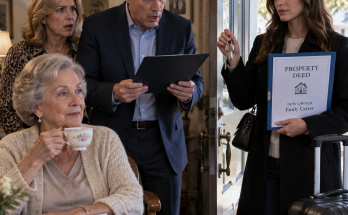
Reagan stared at the document.
Dad looked at her.
Vale kept his weapon aimed loosely toward Carter.
Arthur watched everyone.
I read the authorization again.
The signature looked genuine.
Reagan Dennis.
The date was eleven days before my arrest.
“Is this yours?” I asked.
She swallowed.
“Yes.”
Dad closed his eyes.
I felt strangely calm.
Maybe there was a limit to betrayal. Once you crossed it often enough, another revelation became less like a wound and more like another object placed on a table.
“What did you authorize?”
“A payment.”
“For the garage?”
“I didn’t know that.”
Carter laughed.
“You never know anything until afterward.”
Reagan turned on him.
“You told me the payment was for Mercer.”
My attention sharpened.
“My brother,” she said to me. “He needed money.”
“For what?”
“To get transferred into Oakwood.”
Vale stared.
“You paid for that?”
“No. I paid someone who claimed he could arrange Mercer’s placement.”
Dad said, “You told me the warden moved him there.”
“I lied.”
“Why?”
“Because Mercer had already been placed near Finnley before I understood how.”
I looked at her.
“Start at the beginning.”
Reagan nodded.
“Carter came to me two weeks before your arrest. He said people connected to Kestrel had discovered you were investigating Benton and Harrow.”
“True.”
“Yes. He said you were going to be killed.”
“Also true.”
“I contacted Mercer.”
“Why him?”
“He had served time before. He knew people inside the system. He offered to enter Oakwood on a parole violation so he could stay close to you.”
I stared.
“Your brother deliberately went to prison?”
“Yes.”
“For me?”
“For Claire.”
That answer hurt differently.
“He knew her?”
“Very well.”
“How?”
Reagan glanced toward Arthur.
“Claire recruited both of us.”
Arthur nodded.
“Mercer was useful.”
Reagan’s eyes hardened.
“He was loyal.”
“Those qualities are not mutually exclusive.”
I held up the payment authorization.
“Where did the money go?”
“To an intermediary Carter gave me.”
“And the intermediary rented the garage in my name.”
“I didn’t know.”
Carter smiled.
“She never checked.”
Reagan looked at me.
“He said speed mattered. He said every hour we delayed made you more vulnerable.”
There it was again.
Urgency.
The tool everybody used to make unforgivable choices sound necessary.
“You signed without verifying.”
“Yes.”
“Why use my name?”
“I didn’t. The form I signed had a company code.”
Carter placed another sheet on the table.
The original.
Reagan was right.
Her signature appeared beneath an authorization for “protective relocation expenses.”
The page attached to it had been substituted later.
Vale examined both.
“Same document ID.”
Carter nodded.
“You changed it,” Reagan said.
“No.”
“Then who?”
Carter’s smile vanished.
“That’s the question I’ve been trying to answer for three years.”
Dad laughed bitterly.
“You expect us to believe you didn’t frame Finnley?”
“I helped.”
“Helped?”
“I provided his access logs.”
“You planted equipment.”
“Yes.”
“You lied to investigators.”
“Yes.”
“You planned to kill him.”
Carter’s expression tightened.
“I considered it.”
“Considered?”
“Arthur’s people told me Finnley had discovered enough to destroy everything.”
Arthur said, “My people?”
Carter turned.
“You still pretending?”
Arthur looked genuinely confused.
Carter continued.
“The messages. The account instructions. The debt payments.”
“I paid your debts.”
“Yes.”
“Until when?”
“Until Finnley’s arrest.”
Arthur’s face changed.
“After that, I sent nothing.”
Carter stared.
“What?”
“The last payment I authorized was six weeks before Finnley was arrested.”
Carter laughed.
“That’s impossible.”
Arthur looked toward Vale.
“Check account signatures when you reach Bellweather.”
Carter stopped laughing.
I understood.
Someone had impersonated Arthur.
Or inherited his channels.
“How long did you receive orders afterward?” I asked Carter.
“Three years.”
“Through what?”
“Encrypted messages.”
“Voice?”
“No.”
“Meetings?”
“Never.”
“Money?”
“Yes.”
“From Kestrel accounts?”
“Yes.”
Arthur leaned back.
“Then whoever took control had access to Claire’s codes.”
Reagan whispered, “And knew Arthur was alive.”
Dad looked at her.
“How many people knew?”
“Claire. Me. Mercer eventually. Howard after your crash.”
Vale shook his head.
“I didn’t know until Reagan told me.”
Arthur said, “There was one other.”
Everyone looked at him.
“My wife.”
Vale went still.
“My mother?”
Arthur nodded.
“She knew I planned to disappear.”
Vale stared at him.
“You told me she believed you died.”
“I lied.”
“Where is she?”
Arthur looked down.
“She died eleven years ago.”
Vale stepped away.
Another dead person.
At this point, I almost expected her to walk through the door.
Carter looked at me.
“Now you understand why I wanted the ledger.”
“You said someone ordered you to destroy it.”
“They did.”
“Who?”
“I don’t know.”
“Why obey?”
He looked almost offended.
“Because they paid eight million dollars of my debt and proved they could expose every crime I committed.”
“So you were trapped.”
“I was employed.”
“Same cage, nicer vocabulary.”
His expression hardened.
“You always did sound like Camden.”
“Today everyone says I sound like Mom.”
“That would worry me more.”
I put Reagan’s authorization beside Carter’s altered version.
“We go to Bellweather.”
Dad nodded.
Arthur said, “Take Carter.”
Vale stared.
“Why?”
“Because whoever controlled him may contact him once Finnley accesses the trust.”
Carter smiled.
“You want me as bait.”
“Yes.”
“Finally somebody says it plainly.”
I looked at Carter.
“You come voluntarily.”
“Why would I?”
“Because whoever gave you orders for three years may be the same person who can expose you.”
“They already can.”
“And once we have the account identities, so can we.”
Carter studied me.
“You’re threatening me.”
“I’m explaining aligned interests.”
Dad looked almost proud.
I disliked that.
We left Arthur at the quarry.
Vale stayed long enough to speak privately with him.
I didn’t ask what was said.
For once, somebody else’s family secret could wait.
Bellweather was a private banking facility built into a renovated courthouse two hours west.
During the drive, Dad sat beside me.
Reagan drove.
Carter rode in the rear with Vale.
Nobody trusted him enough to let him out of sight.
Halfway there, Dad said quietly, “You haven’t read the rest of Claire’s letter.”
“There isn’t a rest.”
“She always wrote on both sides.”
I took the page from my jacket.
The reverse looked blank.
Then I remembered the pencil trick Vale used on K-17.
I held the paper toward the window.
Indented writing appeared faintly.
Not enough to read.
At Bellweather, we would examine it.
The bank manager recognized my name before I finished introducing myself.
That was unsettling.
“Mr. Dennis. We’ve been expecting you.”
“For how long?”
“Sixteen years.”
Carter whistled softly.
The manager led us downstairs.
The vault required my identification, a biometric scan, and a sealed code stored with the trust documents.
Vale’s trustee status had indeed expired when Dad was legally declared dead.
I was sole controller.
The vault attendant placed three boxes in a private room.
I opened the first.
Trust documents.
Mom’s records.
The original four million had grown.
The current value was a little over eleven million dollars.
I stared at the number.
Dad said nothing.
Carter looked impressed.
Reagan looked sad.
I understood her reaction better.
This was not an inheritance.
It was evidence that had spent sixteen years earning interest.
The second box contained transaction records.
Vale began matching signatures to codes in the ledger.
Account identities emerged.
Halcyon executives.
A judge.
Two former state officials.
Several corporate officers.
Arthur Vale.
His account showed incoming transfers but also corresponding reversals and evidence-preservation transactions.
Complicated.
Not clean.
Not proof of innocence.
But not what Carter expected.
Then Vale found the transactions that had paid Carter after my arrest.
He compared the signature key.
His face changed.
“What?”
He turned the document toward us.
The authorization code belonged to an account labeled C-9.
“Who owns C-9?” I asked.
Vale searched the identity register.
Nothing.
The page had been removed.
Carter swore.
“Someone got here first.”
The manager heard.
“That is impossible.”
“Apparently not.”
I opened the third box.
Empty except for one photograph.
Mom.
Reagan.
Mercer.
Arthur.
And a fifth person standing partly behind them.
A woman.
I recognized her immediately.
Not because I knew her well.
Because I had seen her every day during my trial.
Assistant District Attorney Eleanor Shaw.
The prosecutor who had convicted me.
My stomach turned cold.
Vale took the photograph.
“She worked financial crimes before becoming a prosecutor.”
Reagan stared.
“I never knew Claire met her.”
Carter laughed softly.
“Oh, that’s bad.”
Dad looked at him.
“You know something.”
Carter nodded.
“The encrypted instructions after Finnley’s arrest used the initials E.S.”
Vale looked at me.
“Could be coincidence.”
“Evidence before people,” I said.
Mom’s rule.
I took out her letter and shaded the reverse with a pencil from the bank desk.
Indented writing appeared.
A final paragraph.
If you have reached the trust, do not assume the person who prosecutes wrongdoing is separate from the people who profit from it. I made that mistake once.
Below it was a single line.
ASK REAGAN WHAT HAPPENED TO ELEANOR.
I looked at Reagan.
She had gone pale.
“What happened to Eleanor?”
Reagan did not answer.
“Mom specifically told me to ask you.”
Carter leaned back.
“This should be interesting.”
“Reagan.”
She closed her eyes.
“Claire discovered Eleanor was leaking information.”
“To Halcyon?”
“We thought so.”
“What did Mom do?”
“She confronted her.”
“When?”
“Two weeks before Claire became ill.”
Dad stood very still.
“What are you saying?”
Reagan looked at him.
“Claire’s cancer diagnosis came after that confrontation.”
Dad frowned.
“She had symptoms before.”
“Yes.”
“But?”
Reagan’s voice dropped.
“She told me Eleanor had threatened her.”
“With what?”
“Finnley.”
I felt the room narrow.
“What threat?”
“She said if Claire exposed Kestrel, her son would spend his adult life paying for it.”
Carter looked at me.
“And thirteen years later, who prosecuted you?”
Nobody needed to answer.
My phone vibrated.
Unknown number.
A message.
I opened it.
A photograph taken through the bank’s front windows.
Us arriving twenty minutes earlier.
Below it:
YOU HAVE SOMETHING THAT DOESN’T BELONG TO YOU.
A second message followed.
BRING THE LEDGER TO THE OLD COUNTY COURTHOUSE AT 6 P.M.
Then a third.
COME ALONE, FINNLEY.
I looked at the sender information.
No number.
But beneath the message was a digital signature.
E.S.
Vale said, “Could be Carter’s controller.”
Carter shook his head.
“The phrasing matches.”
Dad asked, “Matches what?”
“The instructions I received.”
Reagan sat down.
Dad looked at her.
“What else?”
She shook her head.
“What aren’t you saying?”
Reagan looked at me.
“Eleanor Shaw wasn’t just connected to Kestrel.”
“What was she?”
Reagan swallowed.
“Claire believed Eleanor was the person who had corrupted Arthur’s original system.”
Arthur called himself the architect.
Dad built the machinery.
But Mom had apparently identified someone else as the person who transformed Kestrel into a criminal marketplace.
I stared at the photograph of the woman who had stood before a jury and described me as greedy, deceptive, and dangerous.
The woman who had asked the judge for the maximum sentence.
“Eleanor built the laundering network?”
“Claire believed she helped build it.”
“Why wasn’t she in the ledger?”
“She used intermediaries.”
Carter leaned forward.
“And after Finnley’s arrest, she started giving me orders.”
Vale looked toward the bank door.
“If Shaw knows we opened the trust, she knows the account key is exposed.”
“What does she do now?”
Carter answered.
“She erases everyone who can connect her to it.”
My phone vibrated again.
This time the message contained no words.
Only a live photograph.
Arthur Vale sat in the quarry office.
Someone stood behind him with a gun pressed against his head.
The face was outside the frame.
Vale’s breathing stopped.
A final message appeared.
6 P.M.
OR HOWARD BURIES HIS FATHER TWICE.
Click here to continue reading: PART 13: Eleanor Shaw Ordered Me to Trade My Mother’s Ledger for Arthur Vale, but Carter Recognized a Trap Designed to Kill Us Both
The Day I Walked Out of Prison, My Stepmother Told Me My Father Was Dead and His House Was No Longer Mine
Part 12 of 20