Two years after the pond vault was opened, Renee called me on a Thursday morning.
“The state made an offer.”
I knew immediately what she meant.
“The highway?”
“Connector.”
I set down my scissors.
My client watched me through the mirror.
“How much?”
Renee told me.
I laughed.
“What?”
“Remember forty million?”
“Yes.”
“Not even close.”
“Of course.”
The revived transportation project required a strip through the thirty-eight-acre tract.
Not all of it.
The state offered fair-market compensation for the required acreage.
Enough to matter.
Not enough to justify twenty years of greed, fraud and death.
That seemed almost poetic.
“What do you want to do?” Renee asked.
“Get our own appraisal.”
She laughed.
“Daniel would be proud.”
“Daniel would already have three appraisals and a spreadsheet.”
“True.”
We hired independent counsel.
Reviewed the plans.
Negotiated.
Signed only after reading every page.
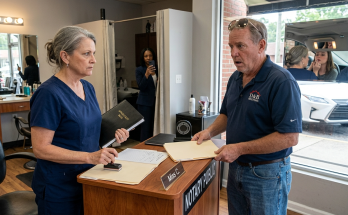
I signed my own name.
Slowly.
Nobody rushed me.
That detail mattered more than the amount.
The remaining land stayed with us.
Renee kept the farmhouse parcel.
I retained my portion of the undeveloped acreage.
We placed restrictions on future transfers so neither of us could pledge the other’s interest without explicit written consent.
Patrice called the arrangement “aggressively cautious.”
I called it experience.
The legal cases ended at different times.
Dale received a substantial prison sentence after pleading guilty to charges connected to Daniel’s death, financial fraud, identity crimes and the attempted asset transfers.
His cooperation reduced some exposure.
It did not erase what he had done.
Dr. Vance was convicted on charges arising from his role in concealing Daniel’s poisoning and other medical misconduct tied to Victor’s network.
Thomas Gentry served time for fraud and related offenses.
Harold Keene was convicted on financial corruption charges.
Marianne received a reduced sentence after extensive cooperation.
None of the outcomes felt large enough to equal the damage.
Courts cannot return eleven years.
They cannot give Daniel another morning.
They cannot make Emily forget learning what her father did.
They cannot convert a broken marriage back into the thing it was before the truth.
Justice was not restoration.
It was accountability.
I learned to accept the difference.
The restitution process lasted longer.
Some families recovered substantial property.
Others received money.
Some claims failed because records were too old or incomplete.
Several borrowers turned out not to be victims at all.
They had knowingly participated with Victor and profited.
Daniel had anticipated that too.
Separate them.
Those two words became more useful than almost anything else he left behind.
Evan eventually produced a full reconstruction of Victor’s network.
The report filled hundreds of pages.
I read the summary.
That was enough.
Victor Lang had built his system over decades by identifying people at moments of vulnerability.
Medical bills.
Failing businesses.
Divorces.
Tax problems.
Property disputes.
He offered solutions.
Then converted dependence into leverage.
Insurance.
Collateral.
Favors.
Silence.
The network survived because nobody inside it believed they could safely be the first person to tell the truth.
Daniel tried.
Dale stopped him.
Then spent years becoming the man he once feared.
That was the central tragedy.
Not that Victor corrupted an innocent person in one dramatic moment.
Dale made choices.
Again and again.
Some under pressure.
Others when the pressure was gone.
After Victor died, Dale could have confessed.
Instead he expanded.
That choice belonged to him.
So did the later choice to fund Daniel’s recovery accounts.
So did his eventual confession.
A person could do something decent after doing something terrible.
The decent act remained decent.
The terrible act remained terrible.
Neither erased the other.
I stopped needing them to.
Emily visited Dale once after his sentencing.
She told me afterward.
I did not ask what they discussed.
She volunteered only one thing.
“He apologized without explaining.”
“That’s new.”
“Yeah.”
“How did it feel?”
“Sad.”
I nodded.
Sad was allowed.
She still loved her father.
She also wanted distance from him.
Those truths could coexist.
Renee restored the farmhouse.
Not into something fancy.
Daddy would have hated that.
She repaired the roof, refinished the floors and replaced the broken porch boards.
We left the scratches in the kitchen table.
The pond filled naturally after the excavation ended.
Fish returned.
So did turtles.
One spring afternoon, Emily and I sat on the bank with cheap fishing rods.
Neither of us was particularly interested in catching anything.
“Did Grandpa really bring you here?”
“All the time.”
“And Uncle Daniel?”
“He cheated.”
“At fishing?”
“He claimed it was strategy.”
Emily smiled.
“What did he do?”
“Dropped corn near his hook before casting.”
“That’s not cheating.”
“Tell that to an eleven-year-old who hasn’t caught anything for three hours.”
She laughed.
The sound carried across the water.
For a second, I could almost hear Daniel answering.
Not literally.
I did not need ghosts.
Memory was enough.
The salon survived the publicity.
For several months, strangers booked appointments mostly because they recognized my name from the news.
I disliked that.
Eventually they stopped.
My regular clients remained.
Ashley became one of them.
She eventually moved to another city for work.
Before leaving, she came in for one last appointment.
“Do you ever wish I hadn’t walked into your salon?”
I considered.
“If you hadn’t, something else might have exposed him.”
“That’s not what I asked.”
“No.”
She waited.
“I wish you hadn’t been hurt.”
Her eyes filled.
“But I don’t wish I knew less.”
She nodded.
“Me either.”
I cut four inches from her hair.
She watched it fall.
“Symbolic?”
“No.”
“Good.”
“Your ends were terrible.”
She laughed.
We hugged before she left.
I never saw her as the woman who destroyed my marriage.
She had not.
My marriage contained its destruction long before she knew my name.
Patrice became a friend, though she continued billing me whenever friendship turned into legal advice.
She claimed professional ethics.
I claimed greed.
We both knew better.
One afternoon she brought me the final order dissolving Harris Construction Holdings.
The company created in my name no longer existed.
I stared at the page.
“That’s it?”
“That’s it.”
“No secret subsidiary?”
“None we know of.”
“Comforting qualifier.”
“I’m a lawyer.”
I signed the acknowledgment.
My real signature.
Again.
“What happens to the name?”
“Nothing.”
“Harris Construction Holdings?”
“Dissolved.”
I looked at it.
For years, strangers had used my identity to make that company appear legitimate.
Now it was a line in a closed file.
“Good.”
The clean proceeds attributable to my property remained invested.
The small-business assistance fund grew slowly.
We helped our first client recover a workshop from a lender using deceptive fees.
The owner was a woman in her fifties.
She cried when the deed issue was resolved.
I thought of Daniel.
Then I thought of myself.
I did not tell her either story.
Her problem deserved to belong to her.
That was another thing I had learned.
Helping someone does not require making yourself the center of their rescue.
On the third anniversary of Daniel’s death after the truth became public, Renee asked whether we should hold a memorial.
“No.”
She looked surprised.
“Why?”
“We’ve held enough funerals for him.”
Instead we cooked dinner at the farmhouse.
Emily came.
Evan came.
Patrice came late.
Even Marianne sent a short letter from prison, though I did not read it aloud.
We talked about Daniel.
Not the investigation.
Daniel.
The time he backed Daddy’s truck into the shed.
The terrible chili he insisted was award-worthy.
The Christmas he gave Renee a vacuum cleaner and spent six months recovering from the decision.
We laughed.
That felt more respectful than turning him into the dead whistleblower from newspaper articles.
After everyone left, Renee handed me a small box.
“I found this behind the pantry cabinet.”
Inside was an old photograph.
Daniel and me beside the pond.
Teenagers.
Sunburned.
Annoyed at whoever held the camera.
On the back, Daddy had written the date.
Nothing else.
I took it home.
It now sits on my bookshelf.
Not beside legal files.
There are no legal files in my living room anymore.
Those live with lawyers.
Where they belong.
I eventually sold the house Dale and I had shared.
Not immediately.
I waited until I knew why I wanted to sell.
That mattered.
I did not leave because the rooms were poisoned by memory.
Some memories there were good.
Emily’s first steps.
Birthday cakes.
Daniel asleep on the couch after Thanksgiving.
Dale teaching Emily to ride a bicycle in the driveway.
Selling the house did not deny those years.
I simply no longer wanted to organize my future around preserving them.
I bought a smaller place.
Big windows.
A little garden.
No hidden corporate mail.
The first night, I sat on the floor because the furniture had not arrived.
Emily brought pizza.
“To no secret companies,” she said, lifting her paper cup.
“That is a very low bar.”
“We’ve earned low bars.”
I laughed.
“To reading before signing.”
“To Mom finally reading before signing.”
“I always read.”
She stared at me.
“Eventually.”
We touched cups.
I received occasional letters from Dale.
I answered some.
Not all.
There was no pattern.
That was intentional.
I did not want obligation to sneak back into my life disguised as compassion.
One letter arrived five years after the investigation began.
Dale wrote that he had joined a prison financial-literacy program.
The irony was obvious.
He acknowledged it himself.
He helped other inmates understand debt, contracts and predatory lending.
I sat with the letter for a while.
Then I wrote back.
Good. Keep doing something useful.
Nothing more.
I did not tell him I forgave him.
I still do not know whether forgiveness is the correct word.
I no longer wake angry.
I no longer imagine conversations where Daniel survives.
I no longer need Dale to suffer every day for me to believe consequences were real.
Maybe that is forgiveness.
Maybe it is simply distance.
The label matters less than I once thought.
What matters is that his choices no longer determine the shape of my days.
The transportation connector eventually opened.
The first time I drove it, I almost laughed.
Cars moved across pavement that Victor had imagined would make him rich decades earlier.
Commuters.
Delivery trucks.
Families headed somewhere else.
Nobody knew what had happened beneath the land.
Nobody needed to.
I exited near the Bell property.
Renee was waiting at the farmhouse.
We walked toward the pond.
The vault had been gone for years.
Grass covered the place where the excavator had stood.
A cypress tree leaned toward the water.
“Daddy would be furious about the highway noise,” I said.
Renee smiled.
“Daniel would be calculating what the remaining frontage is worth.”
“Also true.”
We stood quietly.
Then she asked, “Do you ever think about what would have happened if Daniel had told you everything before meeting Victor?”
“Yes.”
“What would you have done?”
I considered.
The old Carol might have confronted Dale.
Might have believed him.
Might have signed something to make the problem disappear.
Might have saved Daniel.
Might not have.
There was no useful answer.
“I don’t know.”
Renee nodded.
The underrated answer.
“I used to think I needed to know.”
“What changed?”
“I got tired of living inside imaginary versions of the past.”
She looked at me.
“That sounds healthy.”
“Don’t spread it around.”
We laughed.
Before leaving, I walked to the water.
The pond reflected the late-afternoon sky.
For decades, people had looked at this land and seen collateral.
A highway.
Development.
Leverage.
Insurance.
Forty million dollars.
I saw Daddy teaching us to fish.
Daniel cheating.
Mama sitting beneath an umbrella because treatment made sunlight hurt.
Renee bringing sandwiches.
Emily as a child throwing stones.
Land is valuable for reasons spreadsheets cannot calculate.
That did not mean money was evil.
It meant money was only one measurement.
Victor never understood that.
Dale understood too late.
Daniel understood shortly before he died.
I had needed most of my life.
I thought about the first day Ashley sat in my chair.
A stranger wearing a ring connected to my husband.
A few careless sentences.
A question I almost did not ask.
My old life did not end that afternoon.
It had already been built on omissions.
That afternoon simply opened the first door.
Behind it were forged signatures, secret companies, insurance policies, stolen land, hidden ledgers, corrupted professionals, frightened accomplices, and the truth about Daniel.
But there was something else behind it too.
My own name.
For years, everyone else had used it.
Dale signed it.
Daniel signed it.
Companies borrowed against it.
Lawyers placed it on documents.
Banks treated it as consent.
My name became valuable to people precisely because I was not in the room.
That is what changed.
I began showing up.
At banks.
At hearings.
At the farmhouse.
At the pond.
At Dale’s interview.
At my own closing.
At my own divorce.
At every table where somebody once assumed Carol would accept whatever had already been decided.
I showed up.
And eventually there was nothing left for anyone else to sign.
I crouched beside the pond and touched the water.
Cool.
Clear enough to see stones beneath the surface.
Renee called from the porch.
“You staying for dinner?”
“Yes.”
“What do you want?”
“I don’t care.”
“That’s not helpful.”
I smiled.
“Chicken.”
“See? Decisions.”
I stood.
Before walking back, I looked once more across Daddy’s property.
Nothing about it had returned to the way it was.
Daniel was dead.
My marriage was over.
Emily’s relationship with her father had changed permanently.
People had gone to prison.
Money had been returned.
Property had changed hands.
Truth had consequences.
That was the part nobody says when they tell you truth sets people free.
Freedom does not mean restoration.
Sometimes freedom is simply knowing which losses are real.
Which debts belong to you.
Which do not.
Which people you can love from a distance.
Which mistakes you must answer for.
Which signatures are yours to make.
I walked toward the farmhouse.
Renee held the screen door open.
For once, nobody was waiting inside with a hidden document.
No folder.
No ledger.
No confession.
Just dinner.
I stepped through.
And the door closed behind me.
The End
Read more original stories on Feel Every Story.
Every Thursday at Two, My Favorite Client Talked About the Married Man I Slowly Realized Was My Husband
Part 20 of 20